
This guide explains what engineering intelligence is, why traditional tools fall short, what it is built from, and how it shows up in the real world.
What is engineering intelligence?
Engineering intelligence is not a single tool. It is the combination of connected product data and AI that can reason over it, so an engineer, or an AI agent, can ask a question about the product and get a trustworthy, traceable answer. It reframes engineering data as an asset you query, rather than files you search. For a short primer, see what is engineering intelligence; we also laid out the six dimensions of the idea in six degrees of engineering intelligence across the product lifecycle.
Why engineering needs a new approach
The truth about a modern product is scattered across dozens of tools that were never designed to talk to each other. That fragmentation is why cross-domain questions take weeks, why change impact is hard to see, and why AI pilots stall. Engineering intelligence exists to close that gap by connecting the data first, then reasoning over it.
The building blocks of engineering intelligence
Engineering intelligence rests on two foundations working together: a connected data model and AI that can reason over it. The data model is a knowledge graph that unifies every discipline, which is how we build trusted, scalable engineering AI on product data and semantics, and why complex programs such as software-defined vehicles demand a domain-specific knowledge graph. On top of that foundation sits AI that answers questions with full traceability.
Agentic engineering intelligence
The frontier is agentic: AI agents that do not just retrieve information but reason and act across the connected product, transparently. We introduced this in agentic engineering intelligence, and showed how the right interface lets AI search and visual exploration work together in AI can answer your engineering question, the interface shows you what happened.
Engineering intelligence in action
Engineering intelligence is not abstract. It is what lets teams build software-defined vehicles without losing control, why innovative CTOs are mastering SDVs with agentic engineering intelligence, and how Europe can build software-defined defense for a new era.
Measuring engineering intelligence
If it matters, you should be able to measure it. Our Engineering Intelligence Index benchmarks where organizations stand, and our paper on scaling industrial AI from pilots to value lays out the target architecture for getting there. The SPREAD platform is built to deliver engineering intelligence on one governed source of truth, and you can experience the connected model in Product Explorer.
FREE REPORTThe Engineering Intelligence Index 2025How engineering teams are coping with software-defined complexity, and where the leaders pull ahead. Survey data and benchmarks.Get the report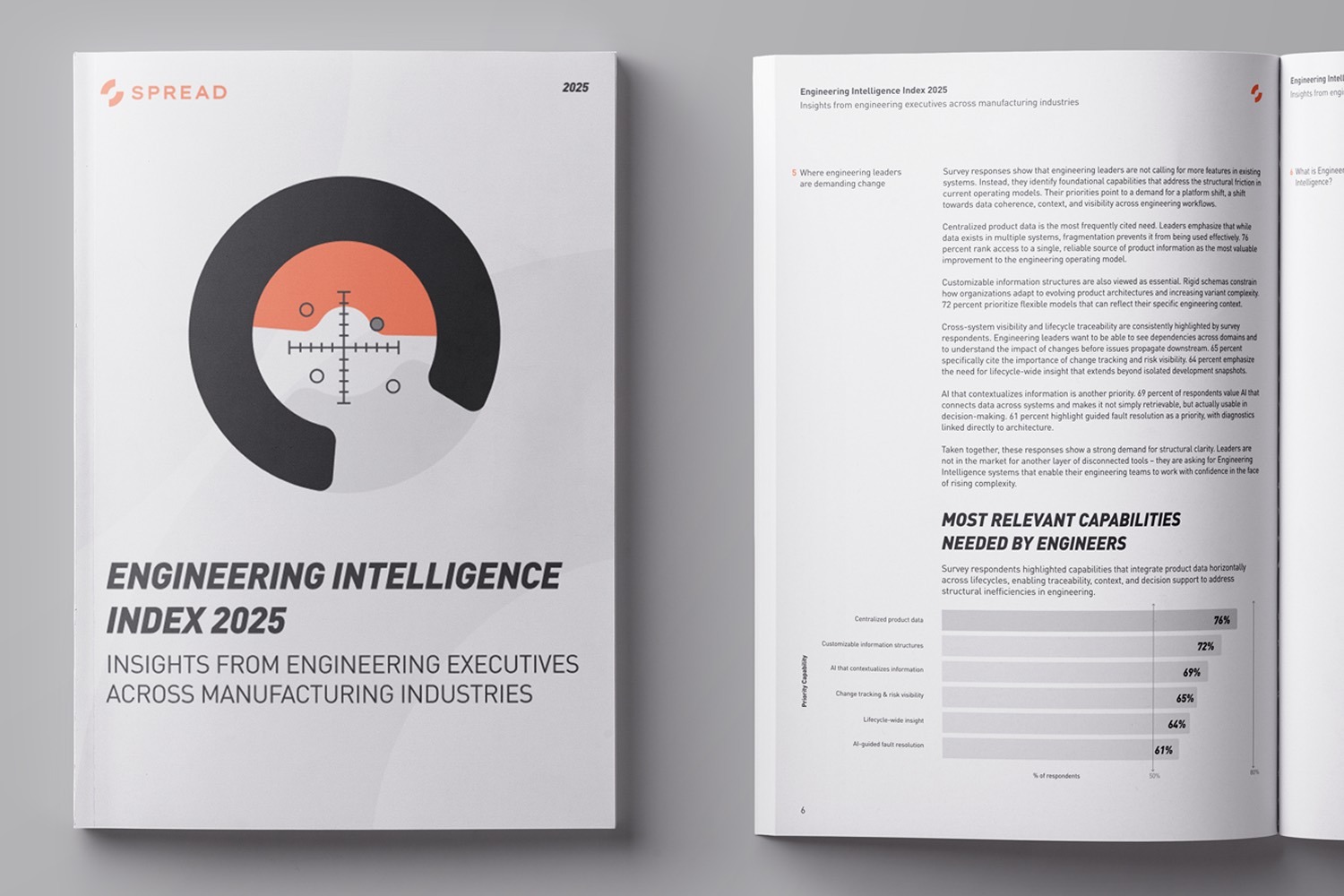
Frequently asked questions
What is engineering intelligence?
Engineering intelligence is the capability to turn fragmented engineering data into trustworthy, queryable answers for people and AI agents, by connecting requirements, functions, software, hardware, and tests into one governed source of truth. It is the layer between raw engineering data and confident decisions.
How is engineering intelligence different from PLM or traditional tools?
Traditional PLM and engineering tools store data in separate systems and documents, so cross-domain questions require manual searching and stitching. Engineering intelligence connects that data into one semantic model and adds AI that can reason over it, so engineers get traceable answers across the whole product instead of files to read.
What is agentic engineering intelligence?
Agentic engineering intelligence uses AI agents that do not just retrieve information but reason and act across a connected product model, transparently. Because the agents work on a governed knowledge graph, their actions and answers are traceable back to real engineering data.
What foundation does engineering intelligence require?
It requires a connected data foundation, typically a domain-specific knowledge graph that unifies requirements, functions, software, hardware, and tests. That foundation is what makes AI answers trustworthy and lets engineering intelligence scale across the enterprise.
The next decade of engineering will not be won by the team with the most data. It will be won by the team that can actually query it.
Want to bring engineering intelligence to your teams? Talk to our team.
Wondering how this differs from your BI stack? Our post on engineering intelligence vs BI breaks down what each tool answers and why engineering questions need connected data, not aggregated metrics.
Want AI you can actually trust with engineering questions? See what makes an AI engineering copilot trustworthy: answers grounded on your connected product data, with every fact traced back to a real record.
Working in automotive? See how the same connected model plays out across the vehicle in engineering intelligence for automotive, from R&D through production to the aftermarket.
Systems engineers going model-based hit the same wall: the model drifts from reality. See how model-based systems engineering stays current when it reads from one connected model instead of manual re-drawing.
Engineering intelligence only works when the data underneath it is connected. See how engineering data management turns scattered PLM, ALM, and signal systems into one navigable model, the foundation the rest of this builds on.