
Engineering data management is the practice of keeping a product's engineering data, its parts, functions, signals, requirements, variants, and the links between them, connected and queryable across the systems that hold it, rather than stored as isolated files in separate tools. The point is not another place to store data. It is one navigable model of the product that anyone can question and trace back to the source. The hard part was never storing the data. It was keeping the connections between it alive.
Most tools that claim to manage engineering data actually manage files: versions, check-ins, access rights. That is document management wearing an engineering badge. Real engineering data management is about the relationships, because the relationships are what every real question depends on.
What engineering data management actually is
For decades, managing engineering data meant managing documents. Product data management (PDM) systems stored CAD files and revisions; PLM extended that to the wider lifecycle. Both are good at custody: who has the latest version, who can edit it, what changed. Neither was built to answer a question that crosses domains, because each stores its own slice and treats the others as attachments.
Engineering data management shifts the unit of value from the file to the connection. Instead of a requirement document, a CAD assembly, and a signal matrix sitting in three systems, the requirement, the part that satisfies it, and the signal it depends on become linked entities you can walk between. The question stops being "where is the file" and becomes "show me everything this change touches." That only works if the data is managed as a connected model, not a shelf of documents.
Why engineering data fragments
The fragmentation is not anyone's fault. It is the natural result of specialized tools, each excellent at its own job, none responsible for the links between them. The information you most need is exactly the information no single system stores.
| Where the data lives | What it holds | What you lose when it stays separate |
|---|---|---|
| PLM | Parts, bills of materials, product structure | No line from a part to the requirement it satisfies or the field issue it caused |
| ALM and MBSE | Requirements, functions, system models | Requirements sit apart from the hardware and software that implement them |
| Signal databases (DBC, ARXML) | Bus communication, signal properties | A signal cannot be traced to the function it serves or the ECU behind it |
| Architecture tooling | ECUs, buses, gateways, topology | The structure is known but not linked to the parts and functions that fill it |
| Variant tables | Which feature ships in which variant | No easy answer to what a change affects across variants |
| Ticketing | Field issues, criticality, affected vehicles | A complaint cannot be tied back to the software release or part that caused it |
Every row is managed well in isolation. The value leaks out between the rows, in the edges that no tool owns. Managing engineering data means owning those edges, so the whole product reads as one graph instead of six disconnected ones.
From storing data to navigating it
Good engineering data management looks less like a vault and more like a map. Three properties separate it from document management.
- One connected model, not six silos. Parts, functions, signals, requirements, and variants are linked by the relationships engineers actually drew: realizes, communicates, satisfies, configures, references. You navigate the product, not the tools that happen to hold pieces of it.
- Answers you can trace. A question returns a specific answer with the path back to the parts, requirements, and tickets it rests on. Every claim is sourced, so an engineer can verify it rather than trust it. Provenance is the difference between a data model and a rumor.
- Change impact before the change ships. Before a part is swapped or a requirement updated, you can walk the radius outward: the variants where it ships, the tests that depend on it, the open tickets that reference it. The cost of a missed dependency drops from a field recall to a review comment.
That last point is where the money is. A premium European automotive group working with SPREAD reports that catching errors at architecture review instead of in the field costs roughly 1,000 times less, worth more than 20 million euros a year on the software-defined vehicle cost curve. The saving does not come from a new tool to store files. It comes from being able to see the dependency before it becomes a defect.
Where connected data and SPREAD fit
SPREAD's Product Explorer is built to manage engineering data as one navigable model. It reads parts, requirements, signals, architecture, variants, and tickets from the systems you already run, PLM, ALM, MBSE, signal databases, ticketing, and resolves them into a single graph with no migration and no manual stitching. You ask a question in plain words and read the traced answer back to the exact entities behind it, with no invented parts and no orphan references. The four interlinked views and the parts, signals, functions, requirements, and variants they connect are documented in the Product Explorer documentation.
Underneath sits one engineering ontology: the prebuilt model of components, functions, signals, requirements, and variants and the edges between them, with every artifact and change logged against it. Because navigation and change impact read from the same model, the radius and the answer always agree. This is the data foundation the wider idea of engineering intelligence is built on, and it is why a connected model, rather than another document store, is what makes change impact analysis trustworthy in the first place.
The proof is in how far one model travels. In SPREAD's customer stories, a global Tier 1 supplier runs a single data model across six OEM customers in place of separate PLM, ERP, ALM, and spreadsheet stacks, and an agricultural machinery OEM has its R&D engineers working from one data view rather than five fragmented sources. The same discipline handles the sprawl of options through dedicated variant management, so complexity stays navigable instead of multiplying into spreadsheets.
FREE REPORTThe Engineering Intelligence Index 2025How engineering teams are coping with software-defined complexity, and where the leaders pull ahead. Survey data and benchmarks.Get the report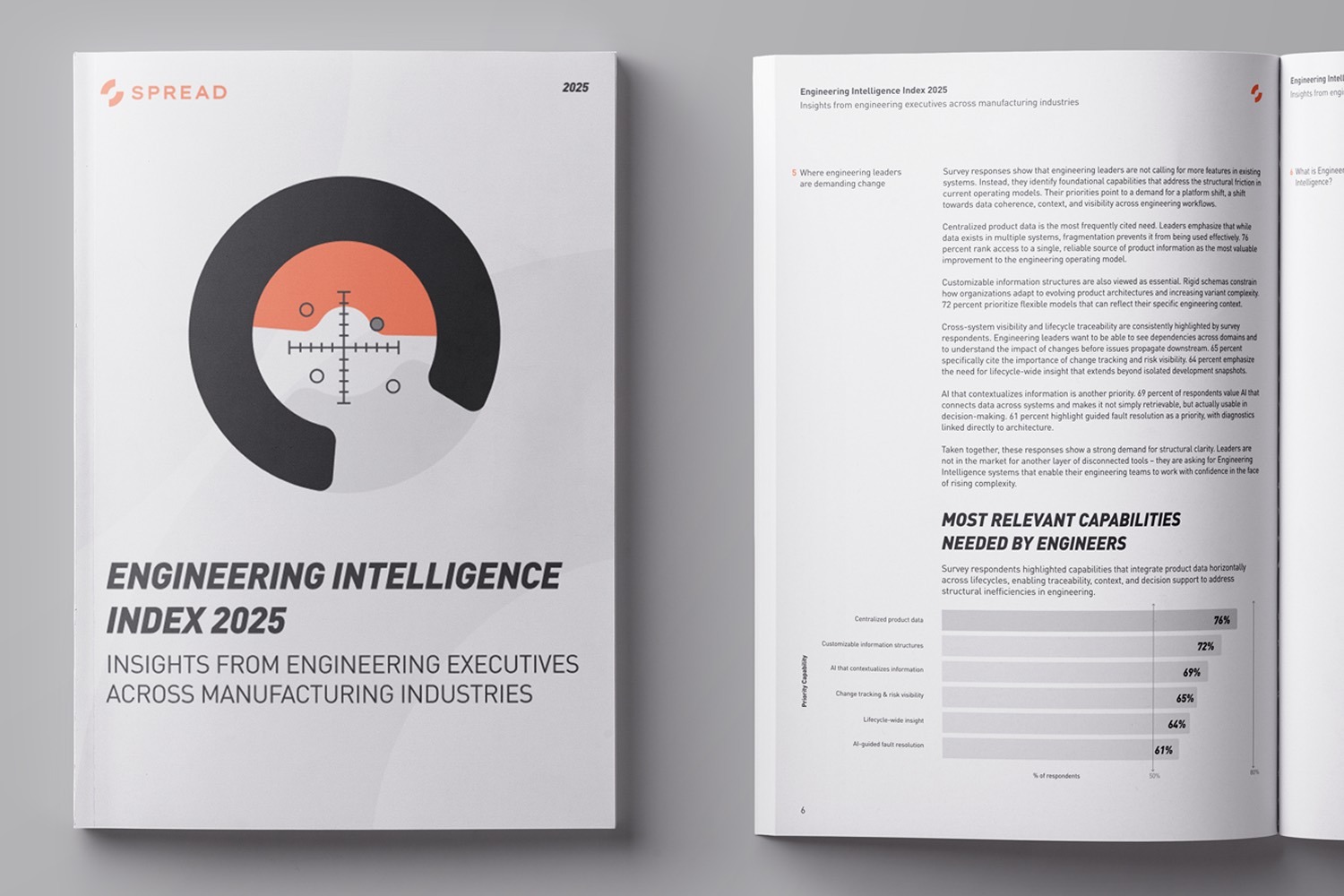
Frequently asked questions
What is engineering data management?
Engineering data management is the practice of keeping a product's engineering data, its parts, functions, signals, requirements, and variants, connected and queryable across the systems that hold it, rather than stored as isolated files. The aim is one navigable model of the product where any entity can be traced to the ones it relates to, so questions that cross PLM, ALM, and other tools can be answered from a single connected source instead of manual stitching.
How is engineering data management different from PLM?
PLM is excellent at custody: storing parts, bills of materials, and revisions, and controlling who can change what. It manages each slice of data well but treats other domains as attachments, so a requirement, the part that satisfies it, and the signal it depends on stay in separate systems. Engineering data management focuses on the connections between those systems, linking the entities into one model you can navigate, so it usually overlays existing PLM and ALM rather than replacing them.
Why is engineering data so hard to manage?
Because it is created in specialized tools that were never designed to share. Parts live in PLM, requirements in ALM, signals in bus databases, and field issues in ticketing, and each is managed well on its own. The information engineers most need, the links between a requirement, a part, a signal, and a ticket, is exactly what no single system stores, so answering a cross-domain question means reassembling those links by hand every time.
Does engineering data management mean replacing PLM and ALM?
No. The practical approach is to connect the systems you already run rather than rip them out. Connectors read parts, requirements, signals, architecture, variants, and tickets from existing tools and resolve them into one connected model in place, with no data migration. PLM and ALM keep doing what they do well; engineering data management adds the layer that links them, so the whole product becomes navigable without a costly replacement project.
The tools that hold your engineering data are not the problem. The missing connections between them are, and connecting them is the whole job.
See your parts, requirements, signals, and variants as one navigable model. Get started with SPREAD.