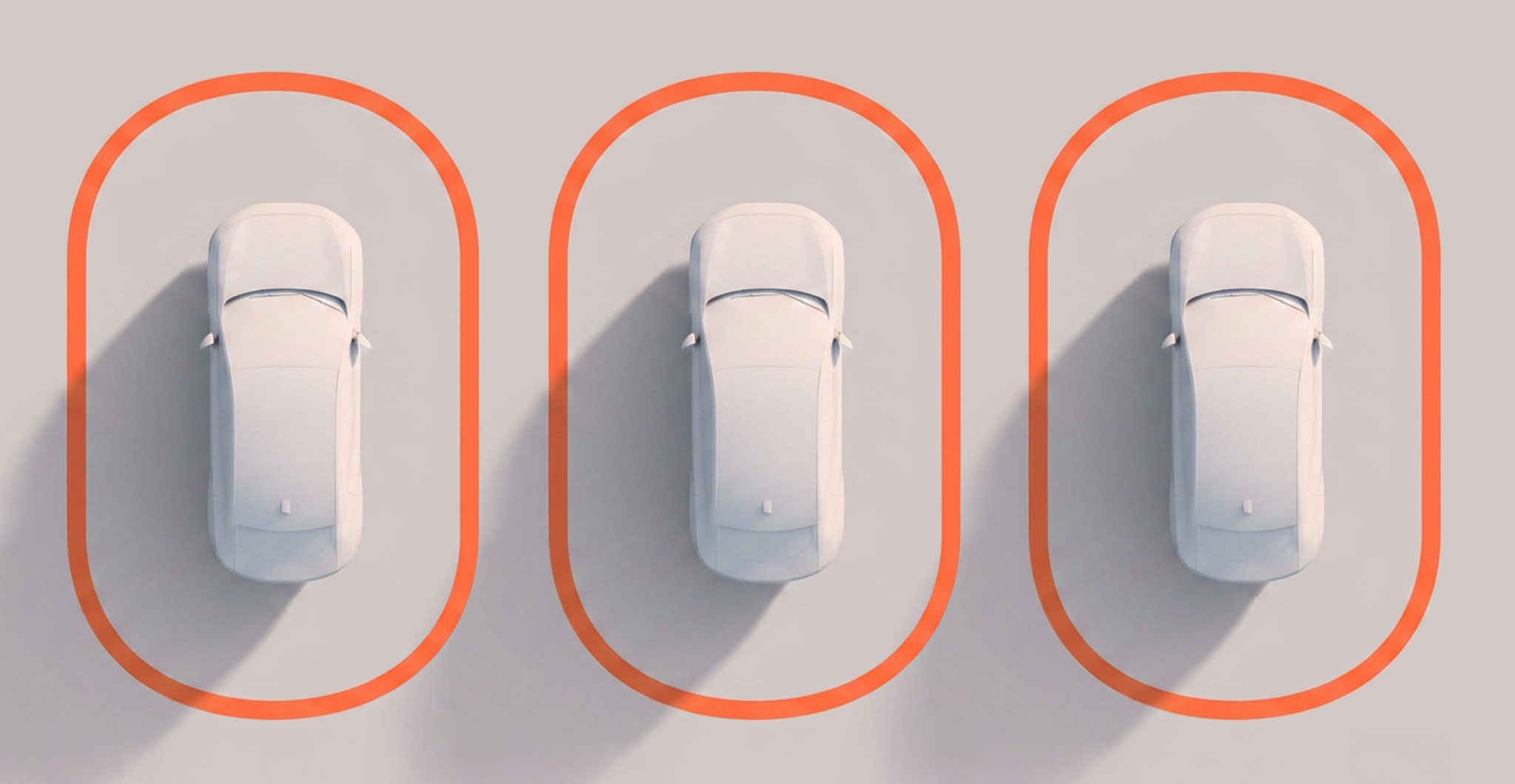
This guide is the map: what an SDV actually is, why it breaks traditional engineering, the four challenges that stall SDV programs, and what "good" looks like when a team gets it right.
What is a software-defined vehicle?
A software-defined vehicle decouples the car's capabilities from its hardware. Instead of freezing functionality at SOP, the vehicle ships as a platform that keeps improving: features arrive over the air, compute is centralized into a few high-performance controllers, and the same hardware can deliver different behavior across variants, markets, and model years.
The implications are bigger than "add more software":
- The product is never finished. It evolves for a decade after it leaves the factory.
- Value moves to software. Differentiation is in features and experience, not sheet metal.
- Everything is coupled. A change in one domain ripples across hundreds of interdependent functions.
That last point is where engineering intuition, honed on mechanical, sequential development, starts to fail.
Why software-defined vehicles break traditional engineering
Traditional automotive engineering relied on stable interfaces, sequential handoffs, and the ability to reason about a change locally. SDVs remove all three. When behavior is defined in software spread across domains, the number of interactions explodes combinatorially, and no engineer can hold the whole system in their head.
We wrote about this shift in depth in why software-defined products broke engineering intuition: the heuristics that made senior engineers fast are exactly the ones that mislead them in a software-defined world.
The four challenges that stall SDV programs
Across OEMs and suppliers, SDV programs tend to stall for the same four reasons.
1. Exploding software and variant complexity
Feature-on-demand, market-specific behavior, and continuous updates multiply the number of valid configurations into the millions. Managing that with spreadsheets and document-based requirements guarantees drift. This is the core argument in zero-surprise development in the era of software-defined products, and why managing requirement chaos and variant complexity has to become a data problem, not a documentation problem.
2. Fragmented engineering data
SDV development spans mechanical, electrical, software, and requirements tools that were never designed to talk to each other. The truth about the product is scattered across dozens of systems, so no one can answer a cross-domain question with confidence. Fixing this is why SDVs demand a domain-specific knowledge graph: a connected model of the product that spans every discipline.
3. Loss of functional control
When a function is realized across software, ECUs, and networks, teams lose the thread between requirement, implementation, and validation. Programs slip not because the work is impossible but because no one can see the whole function end to end. We break down this failure mode, and the fix, in why SDV projects stall and how functional control restores confidence.
4. Falling behind faster competitors
Software-native manufacturers ship, learn, and update on a cadence legacy processes can't match. Closing that gap is a structural challenge, not a willpower one, as we argued in what Europe can learn from China's software-driven auto strategy.
What good SDV engineering looks like
The OEMs pulling ahead share one trait: they treat their engineering data as a connected, queryable product truth, for people and, increasingly, for AI agents. Instead of chasing answers across tools, engineers ask questions against one model of the product and get trustworthy answers with full traceability.
That is the shift from documents to engineering intelligence, and it's why forward-looking CTOs and R&D teams are rethinking their toolchain, a move we cover in mastering SDVs. The SPREAD platform is built for exactly this: unifying fragmented engineering data into one governed source of truth teams can actually query.
How a domain-specific knowledge graph underpins SDV development
Under the hood, the enabler is a domain-specific knowledge graph: a semantic model that connects requirements, functions, software, hardware, and test results into one navigable structure. It's what makes change-impact analysis, variant management, and functional traceability possible at SDV scale, and what lets AI reason over engineering data without hallucinating.
For the technical foundations, our paper on knowledge graphs and LLMs in systems engineering goes deep on the architecture, and you can see the connected model in action in Product Explorer.
FREE REPORTThe Engineering Intelligence Index 2025How engineering teams are coping with software-defined complexity, and where the leaders pull ahead. Survey data and benchmarks.Get the report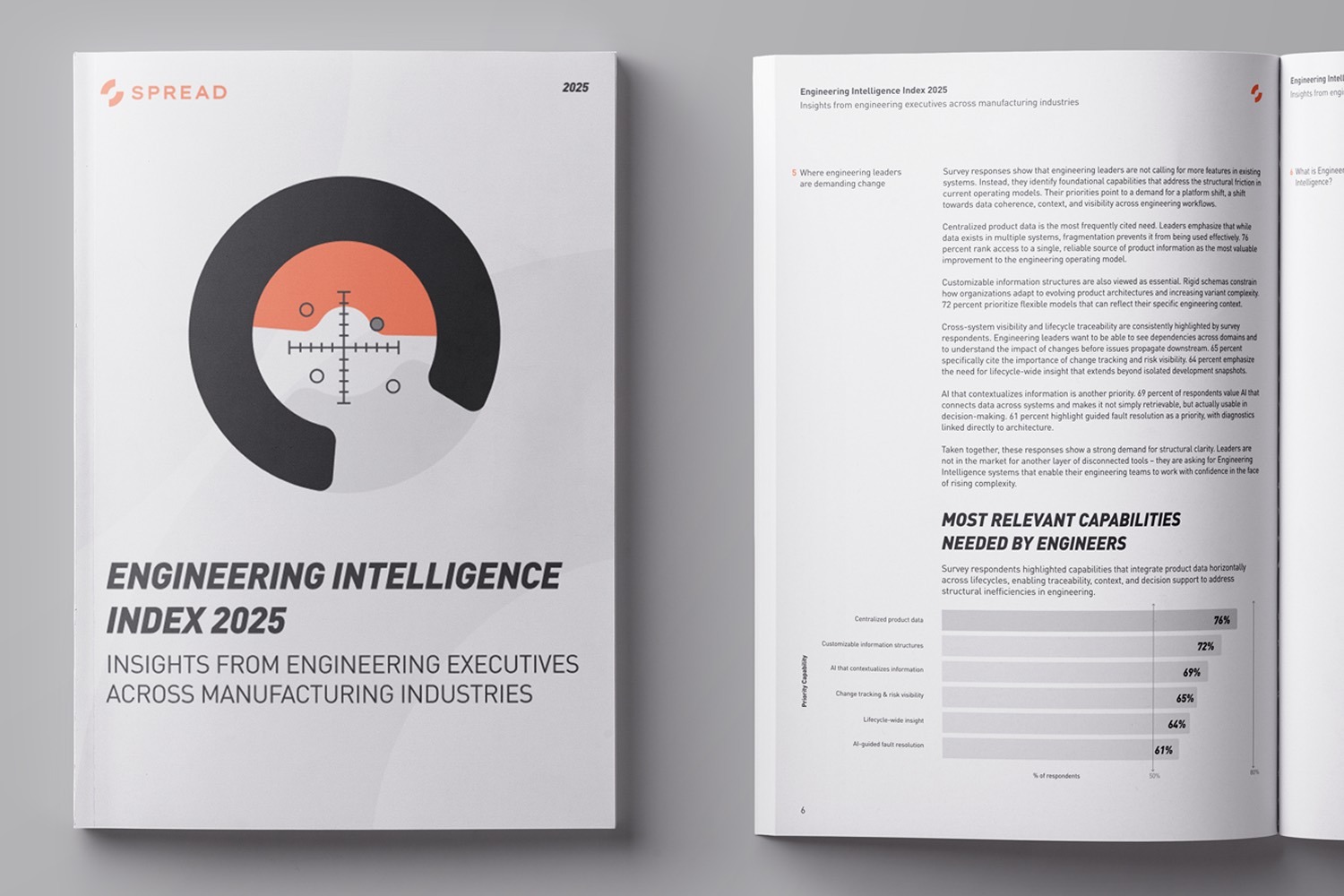
Frequently asked questions
What is a software-defined vehicle?
A software-defined vehicle (SDV) is a vehicle whose features, behavior, and value are defined and continuously updated through software rather than fixed in hardware at start of production. It ships as a platform that improves over the air across its lifetime, with centralized compute and hardware decoupled from functionality.
Why are software-defined vehicle projects so hard?
SDV projects are hard because software-defined behavior couples hundreds of functions across domains, multiplies valid variants into the millions, and scatters the product's truth across disconnected tools. Traditional sequential, document-based engineering can't keep the requirement, implementation, and validation of a function in sync at that scale.
What is functional control in SDV development?
Functional control is the ability to trace a vehicle function end to end, from requirement through software and hardware implementation to validation, and to understand the impact of any change on it. Losing functional control is a leading reason SDV programs slip, because teams can no longer see whole functions across the systems that realize them.
How is engineering data managed in software-defined vehicles?
Leading SDV teams manage engineering data with a domain-specific knowledge graph: a connected, semantic model that unifies requirements, functions, software, hardware, and test data from otherwise siloed tools. This creates one governed source of truth that engineers and AI agents can query with full traceability.
Software-defined vehicles reward the teams that stop chasing data and start querying it.
Ready to build SDVs on a connected source of truth? Talk to our team.
For the structural side of the same shift, see our guide to SDV architecture: the layers, the distributed-to-zonal patterns, and the engineering-data problem centralized compute creates.