An AI engineering copilot is an assistant that answers questions against your connected engineering data, grounding every response in your real requirements, parts, functions, tests, and change history rather than in a language model's training set. A generic copilot predicts plausible text. An engineering copilot retrieves the actual facts of your product and shows where each one came from. Same chat box, completely different source of truth.
What an engineering copilot actually is
The word "copilot" got popular describing tools that autocomplete code. An engineering copilot is a different animal. It is not writing your software for you. It is sitting next to the people who design and build complex products, answering the questions that normally take a day of clicking through PLM, ALM, and a dozen spreadsheets: which requirements drive this function, what changed on this part since the last release, which variants inherit this fault, where this test result came from. The copilot pattern is simple. A human asks in plain language, the system answers from trusted data, and the human stays in control of the decision.
That last part matters. A copilot advises; it does not fly the plane alone. The value is not that it replaces the engineer's judgment, but that it collapses the hours of hunting for context that stand between a question and an informed answer.
Why generic AI copilots fail on engineering questions
Drop a general model into an engineering workflow and it fails in a predictable way. It is fluent about the world in general and blind to your product in particular. Ask it about a component in your system and it will answer in the same confident tone whether it knows the fact or is inventing one, because it has no connection to the systems where that fact actually lives.
The root cause is not the model. It is grounding. Engineering truth is scattered across tools that were never designed to talk to each other, and the questions that matter span all of them at once. A copilot that reads only documents, or only one system, cannot follow a requirement to the function it drives to the software version that implements it to the test that failed. It guesses across the gaps. In a slide deck that reads as intelligence. In a design review it reads as risk.
Generic copilot vs engineering copilot
| Aspect | Generic AI copilot | Engineering copilot |
|---|---|---|
| Answers from | Training data plus loose document search | Your connected product data, modeled under an ontology |
| Cross-system questions | Weak, cannot follow links between tools | Strong, traverses requirements, parts, functions, tests |
| Traceability | Little, answers float free of a source | Every fact traces to a specific record and system |
| Hallucination risk | Higher, the model fills gaps with plausible text | Lower, answers are constrained to real data |
| Best for | Drafting prose, summarizing single documents | Change impact, traceability, root cause across a product |
What makes an engineering copilot trustworthy
Trust is not a personality setting. It comes from two things a copilot either has or does not. First, it answers from a connected model of your product, not from a pile of text, so a multi-hop question resolves by following real relationships instead of matching keywords. Second, it shows its work. Every answer arrives with the records it stands on, so an engineer can click through and verify rather than take the machine's word for it. When both are true, the copilot stops being a party trick and becomes something you can bring into a design review. That is the same reason grounding a model on a knowledge graph beats plain document retrieval: connected facts, and a clean line back to where each one came from. We wrote about the transparency side of this in why the interface should show what the AI did.
Copilot or agent? Know the difference
These two words get used as if they mean the same thing, and they do not. A copilot assists a human in the loop: you ask, it answers, you decide. An agent acts on its own, taking steps toward a goal with far less supervision. We think the copilot comes first, because trust is earned before it is delegated. You let the system answer and cite before you let it act. Our take is copilot now, agents as the ground truth and the guardrails mature. For where that road leads, see agentic engineering, and for the broader category these both belong to, see engineering intelligence.
What this looks like on real product data
A useful engineering copilot is only as good as the data underneath it, which is why the unglamorous work is the connection, not the chat box. SPREAD's platform connects PLM, CAD, ERP, ALM, MES, and simulation systems through connectors, with no data migration, and maps them into the Engineering Intelligence Network using a prebuilt engineering ontology refined over seven years on how requirements, parts, functions, software versions, tests, and traces actually relate. Every artifact, change, and decision is logged against that ontology, so when the copilot answers, each fact traces back to a real record. For a plain-language primer on the category, see what engineering intelligence is, and for the architecture that makes the answers trustworthy, read how SPREAD builds trusted engineering AI. The product docs cover the mapping step in detail.
Where to start
Do not start with the chatbot. Start with the data it will answer from. A copilot bolted onto disconnected systems inherits their gaps and papers over them with fluent guessing. Connect the sources first, model them under one ontology, and the assistant on top gets to be useful and honest at the same time. The chat box is the easy part. The connected product model is the part that decides whether anyone trusts what comes out of it.
A generic copilot sounds like it knows your product. An engineering copilot actually does, and can prove it. For engineering work, that is the only version worth shipping.
See an AI copilot grounded on your own engineering data. Get started with SPREAD.
FREE REPORTThe Engineering Intelligence Index 2025How engineering teams are coping with software-defined complexity, and where the leaders pull ahead. Survey data and benchmarks.Get the report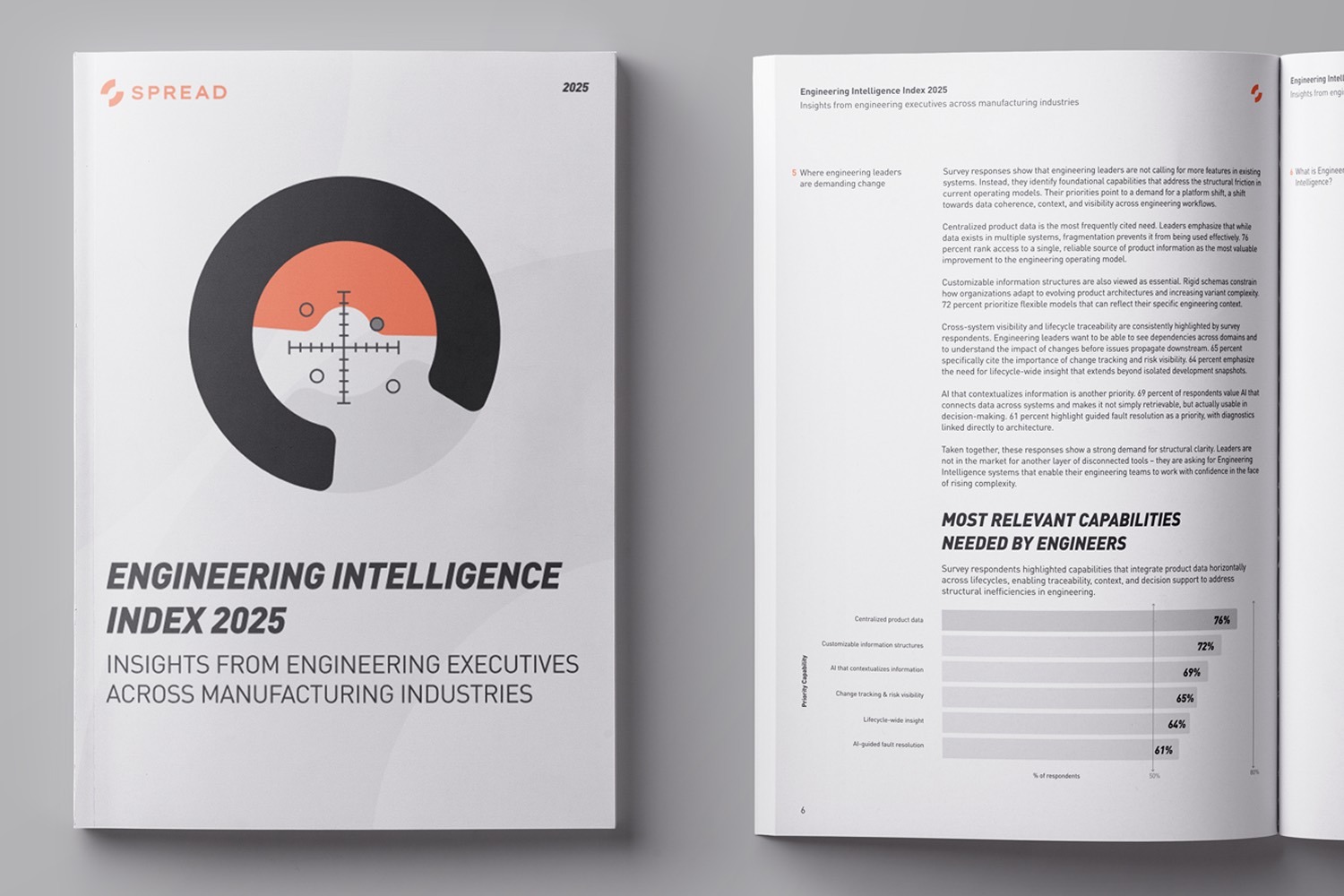
Frequently asked questions
What is an AI engineering copilot?
An AI engineering copilot is an assistant that answers questions against your connected engineering data, grounding every response in your real requirements, parts, functions, tests, and change history rather than in a language model's training set. A human asks in plain language and stays in control of the decision.
How is an engineering copilot different from a generic AI chatbot?
A generic chatbot answers from training data and loose document search, so it cannot follow the links between your engineering systems and it fills gaps with plausible text. An engineering copilot answers from a connected model of your product, handles cross-system questions, and traces every fact back to a specific record.
What is the difference between an AI copilot and an AI agent?
A copilot assists a human in the loop: you ask, it answers, and you decide. An agent acts on its own, taking steps toward a goal with far less supervision. We think teams should adopt the copilot first, because trust is earned before work is delegated.
How do you make an AI engineering copilot trustworthy?
Ground it on a connected model of your product data rather than a pile of documents, so multi-hop questions resolve by following real relationships, and make it show its sources so every answer traces back to a specific record an engineer can verify.
A copilot suggests; an agent acts. See how AI agents for engineering differ from a copilot, what they can do today, and the connected data foundation they need to be trustworthy.