
Engineering intelligence for automotive is the practice of connecting an automaker's fragmented engineering data, requirements, parts, functions, software, tests, and diagnostics, into one traceable model that engineers can query across R&D, production, and the aftermarket. It does not replace your source systems. It connects them, models the relationships between them, and gives every team one place to trace and reason across the whole product. Same data you already have, finally connected.
Why automotive engineering data breaks down
The trouble is not a shortage of data. It is that the data lives in silos that mirror the org chart, not the product. Requirements sit in one tool, the functions that satisfy them in another, the parts that implement those functions in a third, the software versions in a fourth, the test results in a fifth. A single vehicle variant threads through all of them. When something changes, and in automotive something always changes, tracing the impact means stitching those systems back together by hand.
Do that across dozens of variants, multiple model years, and a supply chain that reaches deep into your tiers, and the cost is not abstract. It shows up as slow change impact analysis, defects that survive into production, and warranty claims that take too long to trace back to a root cause. The systems are fine. The lack of connection between them is what hurts.
How engineering intelligence connects the car
SPREAD's platform connects those systems through connectors, reading from and writing back to PLM, CAD, ERP, ALM, MES, and simulation, with no data migration. It maps them into the Engineering Intelligence Network, a connected model built on a prebuilt engineering ontology refined over seven years on how requirements, parts, functions, software versions, tests, and traces actually relate to each other. Your data stays where it is. What changes is that the relationships between it become explicit and queryable.
Once the car is a connected model, the questions that used to take a day resolve in minutes: which requirements drive this function, what changed on this part since the last release, which variants inherit this fault, where this test result came from. Every artifact, change, and decision is logged against the ontology, so each answer traces back to a real record in a real system. For the category in plain language, see what engineering intelligence is, and for the broader guide, the engineering intelligence pillar.
Engineering intelligence across the automotive lifecycle
The same connected model pays off at every stage of the vehicle, not just one. SPREAD organizes its automotive work across three phases.
| Lifecycle stage | The recurring problem | What engineering intelligence does |
|---|---|---|
| R&D | Issues found late, slow impact analysis across tools | Detect issues sooner, troubleshoot faster, and run accurate impact analysis across the connected model. Product Explorer gives a complete view of functions, components, and signals; Requirements Manager turns customer requirements into structured, connected knowledge linked to products, variants, and configurations. |
| Production | Electrical faults and rework drag down first-pass yield | Identify root causes quickly and guide the fix. Connectivity Analyzer builds an exact digital representation of the product and its wiring, in 3D, 2D diagrams, and logical communication paths, so faults are found before they become rework. |
| Aftermarket | Repeat repairs and warranty costs that are slow to trace | Give service teams guided, system-specific diagnostics tied to the exact vehicle variant, so technicians reach a root cause faster and warranty costs and repeat repairs come down. |
For a real automaker's version of this, see how an automotive OEM put a connected engineering model to work. The full application catalogue by lifecycle stage is documented in the product docs.
What automakers get from a connected model
Strip away the product names and engineering intelligence delivers five things an automotive engineering organization can feel.
One connected view. Every team sees the same product model, drawn from the systems they already run, instead of a private export that is stale the moment it is made.
Live, two-way sync. Because the connectors read and write back to the source systems, decisions made in the model flow back to where the work actually happens. There is no second copy of the truth to keep in step.
Traceability by default. Every artifact, change, and decision is logged against the ontology, so a full audit trail is a byproduct of normal work, not a separate project. That matters when the standards auditors come asking.
Composability. Engineering teams build their own apps and analyses on top of the connected model in SPREAD Studio, so new use cases ship without waiting on a platform rebuild.
Fast time to value. Because nothing is migrated, the model connects to your landscape and becomes productive in weeks, not the multi-year replatforming a "rip and replace" would demand.
Where to start
Do not start by ripping anything out. Start by connecting what you already have. The automaker that wins here is not the one with the most tools, it is the one whose tools finally talk to each other. Pick the lifecycle stage where the pain is loudest, connect the systems that feed it, and let the connected model prove itself there before it spreads. The data was never the problem. The distance between your systems was.
A car is already a connected system. Its engineering data should be too.
See what a connected engineering model looks like on your own automotive data. Explore the SPREAD platform.
FREE REPORTThe Engineering Intelligence Index 2025How engineering teams are coping with software-defined complexity, and where the leaders pull ahead. Survey data and benchmarks.Get the report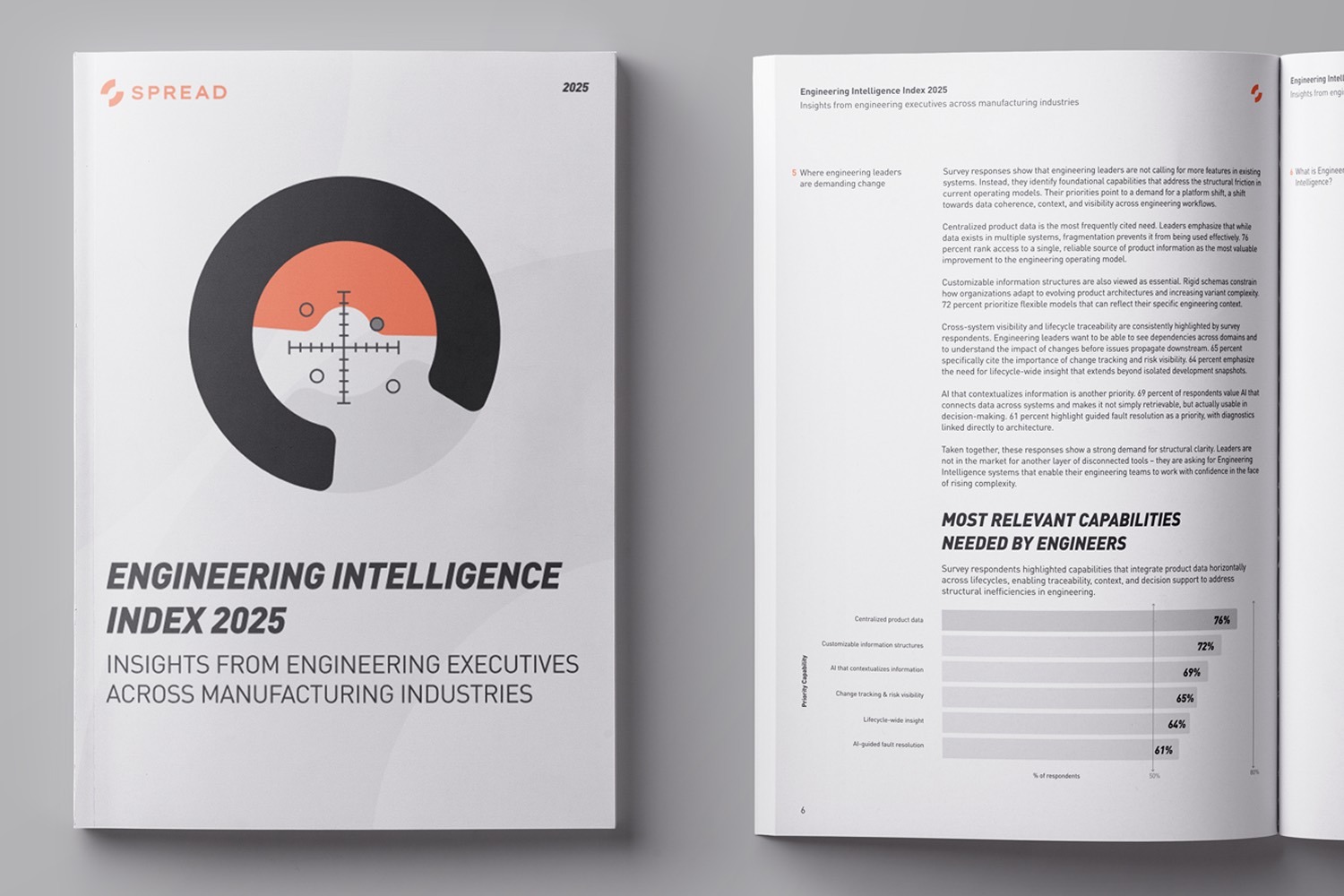
Frequently asked questions
What is engineering intelligence for automotive?
Engineering intelligence for automotive is the practice of connecting an automaker's fragmented engineering data, requirements, parts, functions, software, tests, and diagnostics, into one traceable model that engineers can query across R&D, production, and the aftermarket. It connects existing source systems rather than replacing them.
How is it different from a PLM system?
A PLM system is one of the source systems engineering intelligence connects, not a replacement for it. Engineering intelligence reads from and writes back to PLM, CAD, ERP, ALM, MES, and simulation without data migration, then models the relationships between them so questions that cross several systems can be answered in one place.
Does it work across the whole vehicle lifecycle?
Yes. The same connected model supports R&D, where it speeds up impact analysis and troubleshooting, production, where it helps find electrical faults and root causes before they become rework, and the aftermarket, where it powers guided diagnostics that cut warranty costs and repeat repairs.
How long does it take to get value?
Because engineering intelligence connects to existing systems rather than migrating data, the connected model can become productive in weeks. Teams typically start with one lifecycle stage where the pain is greatest, prove the value there, and expand from that point.