
This guide explains what AI in systems engineering actually is, why most pilots fail, what it can do today, and what it takes to move from a demo to production.
What is AI in systems engineering?
AI in systems engineering applies machine learning and language models to the core work of building complex products: understanding requirements, tracing functions across software and hardware, analyzing the impact of a change, and answering cross-domain questions. The goal is not to replace engineers, but to give them and their AI agents a fast, reliable way to reason over the whole product.
The distinction that matters is grounding. General-purpose AI guesses from patterns in text. Useful engineering AI reasons over your actual product data, so its answers are traceable and correct.
Why most AI pilots in engineering fail
Most engineering AI pilots stall for the same reason: they are built on top of fragmented, ungoverned data, so they cannot produce answers an engineer would stake a decision on. We break down this pattern in why most AI pilots fail and what top OEMs do instead. Scaling past the pilot is an architecture problem, not a model problem, which is exactly the argument of our paper on scaling industrial AI from pilots to value.
What AI can actually do in systems engineering today
Set aside the hype and the practical use cases are concrete:
- Requirements intelligence. Turning past projects and documents into structured, reusable knowledge, as covered in requirements management in the age of AI.
- Change impact and traceability. Answering "what does this change affect?" across domains in seconds instead of weeks.
- Lifecycle intelligence. Bringing AI into product lifecycle management, the shift we describe in AI in PLM and intelligent product lifecycle management.
Why trust is the real bottleneck
The hard part of engineering AI is not generating an answer, it is generating an answer engineers can trust. That means designing for verifiability, not just accuracy, a principle we explore in designing AI features engineers can actually trust, and in the case for deliberate friction in AI UX. Under the hood, trust comes from building AI on product data and semantics, which is how we build trusted, scalable engineering AI.
The foundation: connected engineering data
AI in systems engineering is only as good as the data it reasons over. A knowledge graph that connects requirements, functions, software, hardware, and tests gives AI a factual structure to work from, which is why complex programs like software-defined vehicles demand a domain-specific knowledge graph. The architecture pairing knowledge graphs with language models is detailed in our paper on knowledge graphs and LLMs in systems engineering. It is also the backbone of engineering software-defined vehicles at scale.
From pilots to production
Turning a promising demo into daily practice is an industrialization challenge: governed data, clear workflows, and measurable value. The same lesson holds in manufacturing, where AI needs engineering context to move the numbers, as shown in industrial AI in discrete manufacturing. The SPREAD platform is built to take engineering AI from pilot to production on one governed source of truth, and you can see the connected model behind it in Product Explorer.
WHITEPAPERScaling Industrial AI from Pilots to ValueA practical target architecture for taking AI beyond isolated pilots, from the team behind the engineering intelligence layer.Get the whitepaper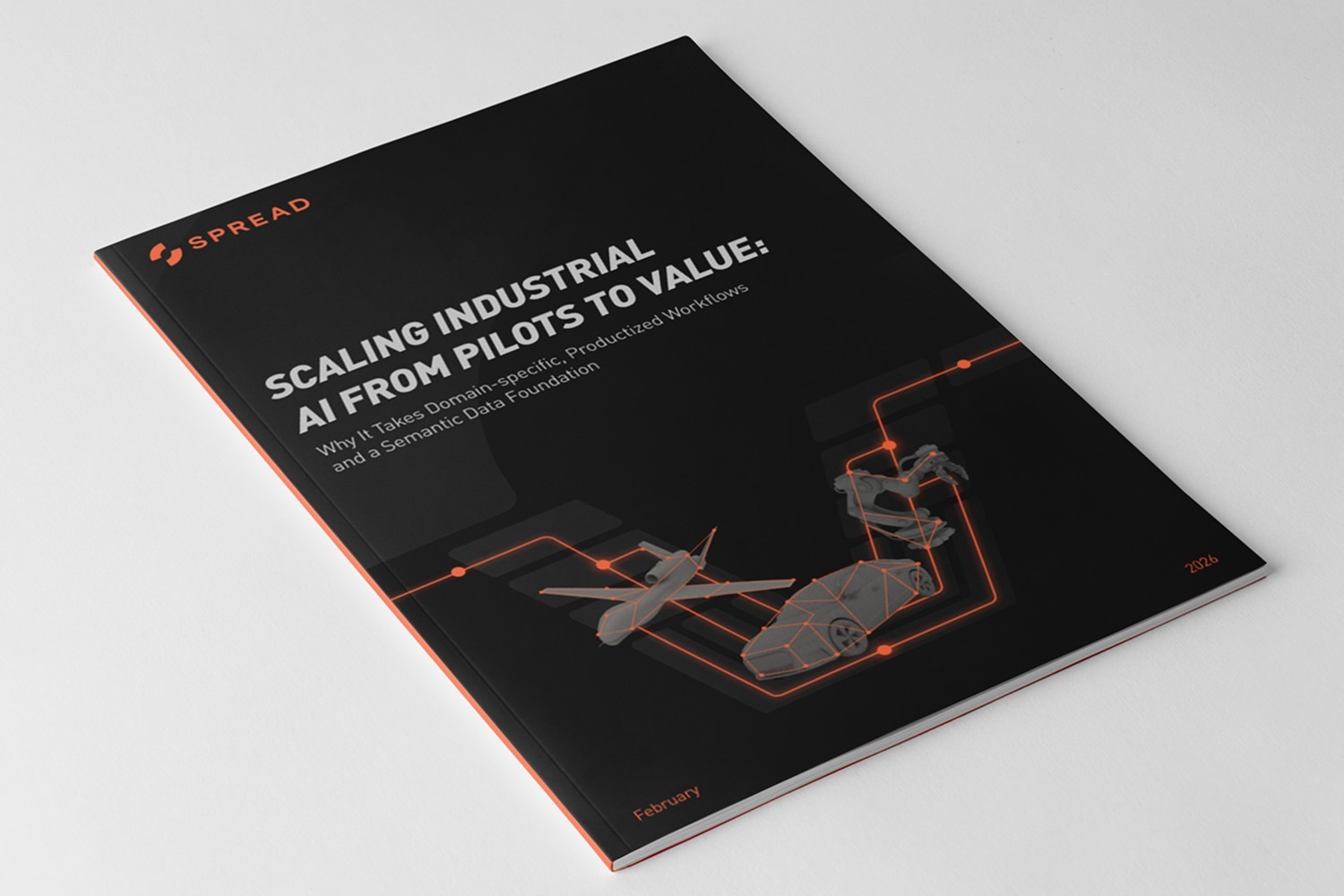
Frequently asked questions
What is AI in systems engineering?
AI in systems engineering is the use of artificial intelligence, especially large language models and AI agents grounded in connected engineering data, to help teams design, trace, validate, and maintain complex products. Its purpose is to turn scattered engineering data into trustworthy, traceable answers for engineers and their AI agents.
Why do most AI pilots in engineering fail?
Most engineering AI pilots fail because they are built on fragmented, ungoverned data, so they cannot produce answers an engineer would trust for a real decision. Scaling past the pilot is primarily an architecture and data problem, not a model problem, which is why a connected, governed data foundation matters more than the choice of model.
How do you make AI outputs trustworthy in engineering?
You make AI trustworthy by grounding it in a connected model of the product, so every answer is traceable back to real engineering data instead of guessed. Designing for verifiability, letting engineers see the source and reasoning behind an answer, matters more than raw accuracy in high-stakes engineering.
What data does AI in systems engineering need?
It needs connected, semantic engineering data: requirements, functions, software, hardware, and test data linked into one navigable structure, usually a knowledge graph. That connected foundation is what lets AI reason across domains and answer cross-domain questions correctly.
The teams winning with AI in engineering did not buy a better model. They built a better foundation.
Want to see AI work on your engineering data? Talk to our team.
Modeling the system is only half the job. See what happens to model-based systems engineering when the model loses touch with the requirements, parts, and tests that change every week, and how connected data keeps it true.