
Agentic engineering is the practice of putting AI agents to work inside an engineered system of goals, context, tools, checks, and human accountability. In software, agents can write and test code. In complex product development, they can trace requirements, assess change impact, or assemble review evidence across engineering data. The domain changes, but the discipline does not: agents execute bounded work, while engineers remain responsible for the result.
What does agentic engineering mean?
The term is often used as the production-minded alternative to "vibe coding." A prompt alone is not an engineering system. Agentic engineering adds structure around the model: a clear specification, access to the right sources, permission boundaries, tests or validation rules, an audit trail, and a person who approves consequential decisions.
That definition extends beyond code. A vehicle, aircraft, or industrial machine is developed across requirements, functions, software, hardware, tests, production records, and field data. An agent working in that environment needs more than a repository. It needs a connected representation of the product and rules for how it may act on that information.
Agentic engineering in software vs product development
| Dimension | Software development | Complex product development |
|---|---|---|
| Typical work | Write code, generate tests, review changes, update documentation | Trace requirements, assess change impact, investigate failures, assemble compliance evidence |
| Core context | Codebase, specifications, issues, documentation, test results | PLM, CAD, ERP, ALM, MES, simulation, test, and field systems |
| Validation | Builds, tests, static checks, code review | Product rules, traceability, variant scope, engineering review, safety and compliance checks |
| Human role | Define, orchestrate, review, and approve | Define, supervise, validate, and retain the final call |
Both forms depend on the same operating principle. The agent should not decide that its own work is correct. It needs evidence from the system around it, plus a review path that makes accountability explicit.
How agentic engineering works
A useful agentic workflow has five parts. First, an engineer defines the outcome and constraints. Second, the agent receives scoped access to the tools and information required for the task. Third, it plans and executes a sequence of actions. Fourth, the system checks the result against tests, product rules, or traceability requirements. Fifth, a person reviews the evidence and approves, rejects, or redirects the work.
This is what separates an agent from a chatbot. A chatbot returns an answer. An agent can plan, use tools, change state, respond to the result, and leave a record of what it did. That extra capability creates value, but it also increases the need for boundaries and reliable context.
Why product engineering agents need connected data
An agent reasoning about a product must know what a requirement is, which part satisfies it, which software version ships in which variant, and which test proves it. In most companies, that knowledge is spread across tools that do not share a vocabulary. No model can reliably infer product truth when "part," "component," and "item" mean different things in different systems.
A shared product ontology normalizes those entities, attributes, and relationships, so an agent reads one consistent picture instead of stitching together conflicting exports. On SPREAD's engineering intelligence platform, the Product Ontology is built on years of refinement across requirements, parts, functions, software versions, tests, and traces. A customer's own variants, programs, and regulatory schemas extend that foundation.
Connectors map PLM, CAD, ERP, ALM, MES, simulation, and test systems in place, with no migration. The data stays in its source systems while agents and applications reason over one connected model. This is the product-engineering equivalent of giving a coding agent the right repository, specification, tools, and test suite.
What agentic engineering looks like in practice
With that foundation, agents can complete bounded engineering jobs rather than produce plausible text. An agent can trace a requirement to the parts and tests that satisfy it, check how a proposed change propagates across variants, identify missing evidence for a design review, or prepare a failure investigation with every source attached.
SPREAD's applications and agents, including Requirements Manager, Product Explorer, Error Inspector, and agents teams build themselves, read from the same Product Ontology. A change in one system can therefore be assessed across the others in context. One European automotive group uses this shift-left approach to catch errors during architecture review, where a fix costs roughly a thousand times less than the same error found in the field. The low-code SPREAD Studio lets domain experts assemble apps and agents on connected data.
Agentic engineering vs a chatbot or copilot
A chatbot retrieves or generates information and leaves the next step to the user. A copilot assists inside a human-led workflow. An agent can pursue a goal through several tool calls and return a completed result. These categories can overlap, but the accountability boundary should remain clear.
| Capability | Chatbot or copilot | Agentic system |
|---|---|---|
| Primary output | Answer, suggestion, or draft | Completed bounded task plus evidence |
| Tool use | Usually limited or user-directed | Plans and uses approved tools across steps |
| Validation | User checks the response | System checks plus human review |
| Accountability | Human owns the next action | Human defines boundaries and approves consequential outcomes |
For a closer look at that progression, read our guide to AI engineering copilots and our practical overview of AI agents for engineering.
Agentic engineering vs agentic engineering intelligence
Agentic engineering is the broad practice of orchestrating AI agents inside a controlled engineering workflow. Agentic Engineering Intelligence is SPREAD's application of that practice to complex product development, grounded in connected and governed product data. The first term names the working method. The second describes how SPREAD makes agentic work transparent and traceable across the product lifecycle.
If you want the wider data and decision layer around it, our guide to engineering intelligence explains how connected product data supports people, applications, and agents.
How to keep agentic engineering trustworthy
Trust does not come from model confidence. It comes from the surrounding engineering system. The agent needs governed context, limited permissions, explicit checks, traceable actions, and a human escalation path. In a software workflow, that can mean a specification, a sandbox, automated tests, and code review. In a safety-critical product workflow, it also means product relationships, variant scope, compliance rules, and evidence tied back to source data.
On SPREAD's platform, artifacts, changes, and decisions are logged against the Product Ontology, so evidence can accumulate during normal work instead of being reconstructed later. A human remains in the loop for consequential steps. One global Tier 1 supplier uses a single connected data model across PLM, ERP, ALM, Excel, and tribal knowledge for six OEM customers. Explore that connected model in Product Explorer.
FREE REPORTThe Engineering Intelligence Index 2025How engineering teams are coping with software-defined complexity, and where the leaders pull ahead. Survey data and benchmarks.Get the report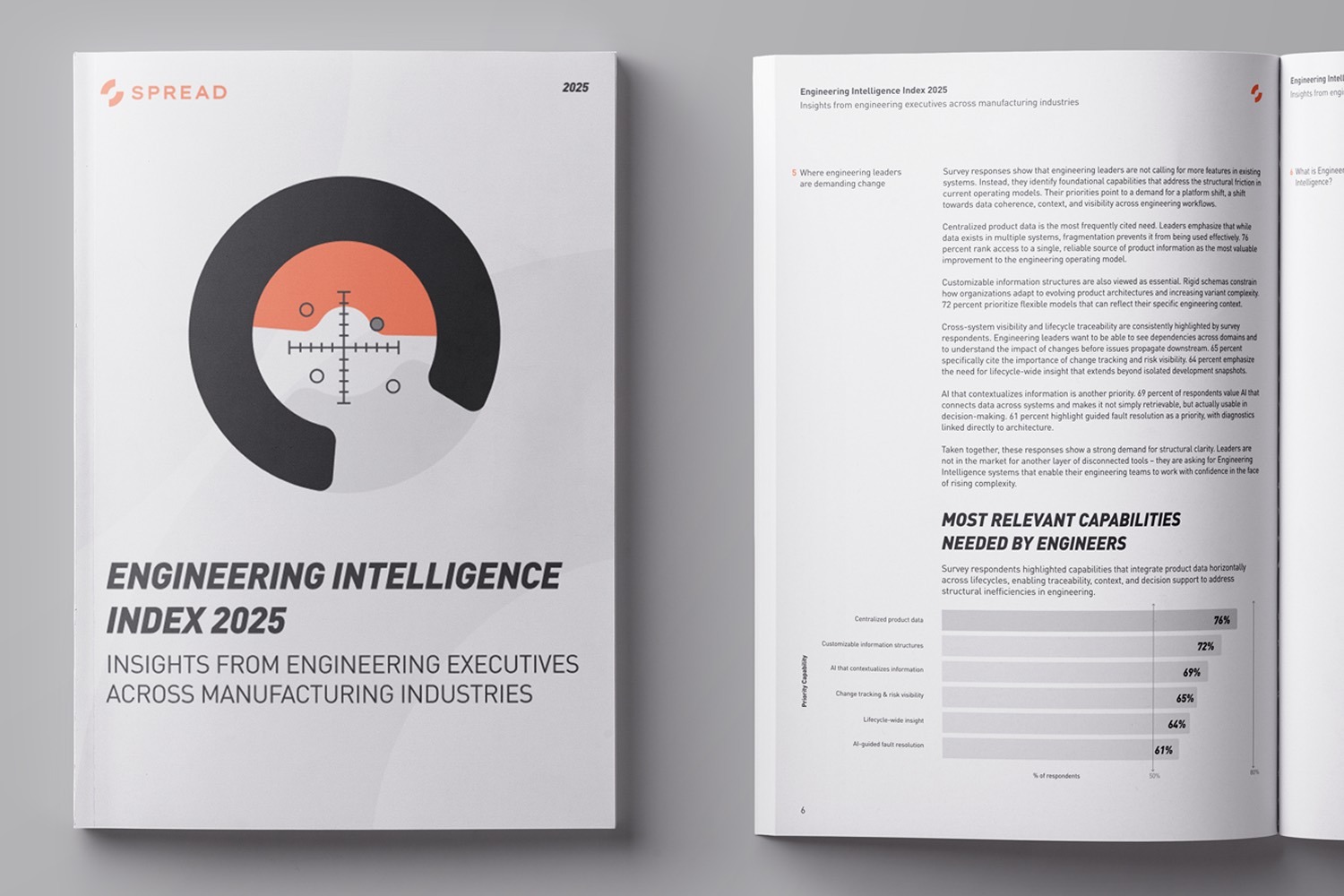
Frequently asked questions
What is agentic engineering?
Agentic engineering is the practice of putting AI agents to work inside an engineered system of goals, context, tools, checks, and human accountability. In software development, agents may write and test code. In product development, they may trace requirements or assess change impact across engineering data. In both cases, engineers define the boundaries and remain responsible for the result.
Is agentic engineering only about software development?
No. The term became popular in software development, where engineers orchestrate coding agents and validate their output. The same discipline applies to complex product development when agents work across requirements, parts, software, tests, and field data. The tools and validation rules change, but scoped execution, evidence, and human accountability remain essential.
How is agentic engineering different from an AI copilot?
An AI copilot usually answers, suggests, or drafts inside a human-led workflow. An agentic system can plan and complete a bounded task through several tool calls, respond to intermediate results, and return evidence of what it did. A human still defines its permissions and approves consequential outcomes.
What does agentic engineering need to work?
It needs clear goals, reliable context, approved tools, validation checks, traceability, and human oversight. For complex products, reliable context also requires connected engineering data, so the agent can follow relationships among requirements, functions, parts, software versions, variants, and tests instead of guessing across disconnected systems.
Agentic engineering does not remove engineers from the loop. It gives them a system for delegating more work without delegating accountability.
See what agents can do on a connected product model. Get started with SPREAD.