
GraphRAG (graph retrieval-augmented generation) grounds a language model on a knowledge graph, so instead of retrieving chunks of text that look like your question, it retrieves connected facts and the relationships between them. Standard RAG finds passages that resemble the question. GraphRAG follows the links between real entities, which is what makes its answers traceable and much harder to hallucinate. Same goal, better place to look.
What RAG is, and where it falls short
Retrieval-augmented generation is the standard way to make a model answer from your data instead of its training set. You split your documents into chunks, turn each chunk into a vector, and at query time pull back the chunks whose vectors sit closest to the question. Those passages become the context the model answers from. For a pile of unstructured text, it works, and it is cheap.
It breaks on connection. Vector similarity retrieves text that resembles your words, not text that holds the answer. So a question whose answer lives two or three hops away (this requirement drives that function, which runs on this software version, which failed this test) rarely assembles from loose passages. And because the chunks are only loosely related, what you get back is hard to verify: an answer, but no clean line to where each fact came from.
What GraphRAG adds
GraphRAG changes exactly one thing: what you retrieve from. Instead of a bag of text chunks, the source is a knowledge graph, where entities are nodes, relationships are edges, and the whole thing is organized under an ontology. That single change fixes all three failures. Relationships are retrieved directly, because they are stored as first-class edges rather than reconstructed from prose. Multi-hop questions resolve in a single traversal instead of a lucky keyword match. And every fact the model sees traces back to a specific node and its source, so the answer arrives with its receipts. The model still writes the sentence. It just no longer has to invent the facts underneath it. For a plain-language primer, see knowledge graphs explained, and for how graphs differ from the databases you already run, see knowledge graph vs relational database.
GraphRAG vs standard RAG: a practical comparison
| Aspect | Standard RAG | GraphRAG |
|---|---|---|
| Retrieves from | Text chunks ranked by vector similarity | Knowledge graph of entities and relationships |
| Sees relationships | No, each chunk stands alone | Yes, follows edges between entities |
| Multi-hop questions | Weak, related context often missed | Strong, traverses the graph directly |
| Traceability | Hard, answers tied to loose passages | Every fact tied to a node and source |
| Hallucination risk | Higher, the model fills gaps | Lower, answers constrained to the graph |
| Best for | Unstructured documents, FAQs, chat | Connected, cross-domain, high-stakes data |
How GraphRAG works, in brief
Three stages, and only one of them is about the language model. First, build the graph: extract entities and relationships from your sources, or connect data you already have under a shared ontology. Second, retrieve: when a question comes in, find the entities it touches and pull the connected subgraph around them, optionally blended with a vector search for the fuzzy edges. Third, generate: hand that structured context to the model, which answers from connected facts and cites each one. The hard, unglamorous work is the graph, not the prompt. Retrieval quality is capped by graph quality, which is why teams that pour their effort into prompt engineering and skimp on the graph end up with a confident model retrieving from a mess.
Why this matters for engineering
A complex product is the worst case for plain RAG and the best case for a graph. Its facts are scattered across tools that were never meant to talk to each other: requirements in one system, functions in another, software and test results somewhere else again. The questions engineers actually ask (what breaks if we change this part, which variants inherit this fault, where this requirement came from) are multi-hop by nature, and vector search cannot reach across those gaps. Ground an assistant on the documents alone and you get confident guessing. Ground it on a connected product graph and you get answers an engineer can check, which is the whole difference between a demo and a tool people trust.
That is the design of SPREAD's platform. It connects PLM, CAD, ERP, ALM, MES, and simulation systems through connectors, with no data migration, and maps them into the Engineering Intelligence Network using a prebuilt engineering ontology refined over seven years on how requirements, parts, functions, software versions, tests, and traces actually relate. That connected model is what an engineering knowledge graph looks like in practice. For the longer version, we wrote up how SPREAD builds trusted engineering AI, and the product docs cover the mapping step in detail.
Where to start
The honest answer is that you do not always need a graph. If your data is mostly documents (FAQs, manuals, unstructured text) and your questions are answerable from a single passage, standard RAG is cheaper and perfectly good. Start there. Reach for GraphRAG when the connections are the answer: change-impact analysis, traceability, root-cause work that crosses systems. And when you do, spend your first effort on the graph, not the prompt. Connect your sources, model them under one ontology, and retrieval quality follows.
Standard RAG retrieves text that looks like your question. GraphRAG retrieves the facts that answer it, and shows its work. For connected data, that is the whole game.
See AI grounded on your own engineering knowledge graph. Get started with SPREAD.
WHITEPAPERKnowledge Graphs and LLMs in Systems EngineeringHow connected product data and language models improve traceability and cut engineering effort in complex systems.Get the whitepaper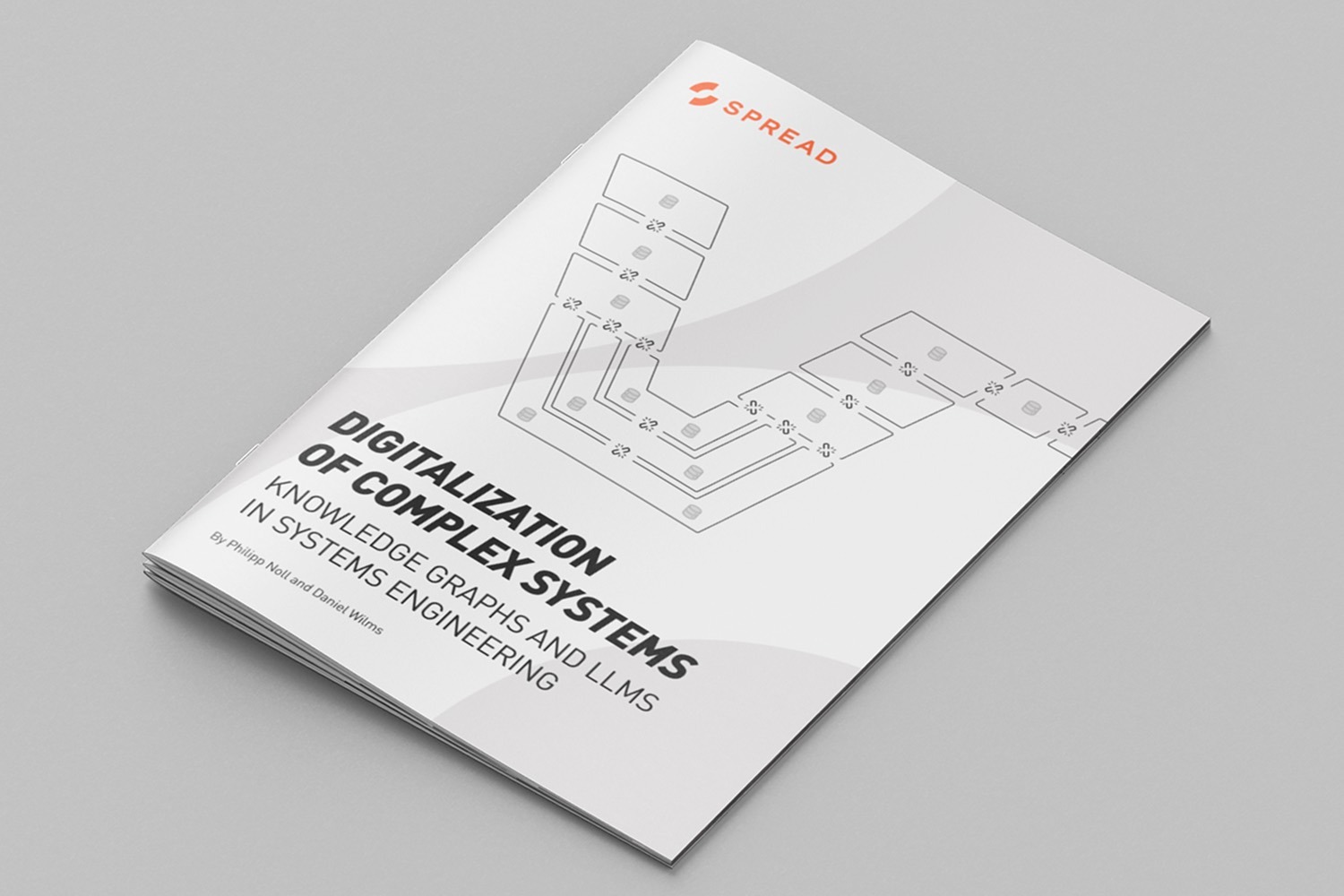
Frequently asked questions
What is GraphRAG?
GraphRAG, or graph retrieval-augmented generation, is a technique that grounds a large language model on a knowledge graph instead of on a pile of text chunks, so it retrieves connected facts rather than loosely similar passages.
What is the difference between RAG and GraphRAG?
Standard RAG retrieves by vector similarity and cannot see how passages relate. GraphRAG follows the connections between entities, so it handles multi-hop questions like change-impact analysis and traceability far better, and its answers are easy to verify.
Does GraphRAG reduce hallucinations?
It reduces them, but does not eliminate them. Because the model retrieves connected facts from a graph rather than similar-looking text, it has less room to invent relationships, and every fact traces back to a specific source node.
When should I use GraphRAG instead of standard RAG?
Use standard RAG for mostly unstructured documents that can be answered from a single passage. Reach for GraphRAG when the value is in the connections, when questions span multiple systems, or when answers need to be traceable, such as change-impact or root-cause work across a complex product.