The AI industry has learned to count progress in tokens. First 128k. Then 200k. Then one million. The number gets bigger, the demos get smoother, and the difficult engineering questions remain difficult.
Context window limits are the gap between how much input a language model can accept and how much of that input it can reliably reason over. A model may have room for the whole library and still lose the plot halfway through the book.
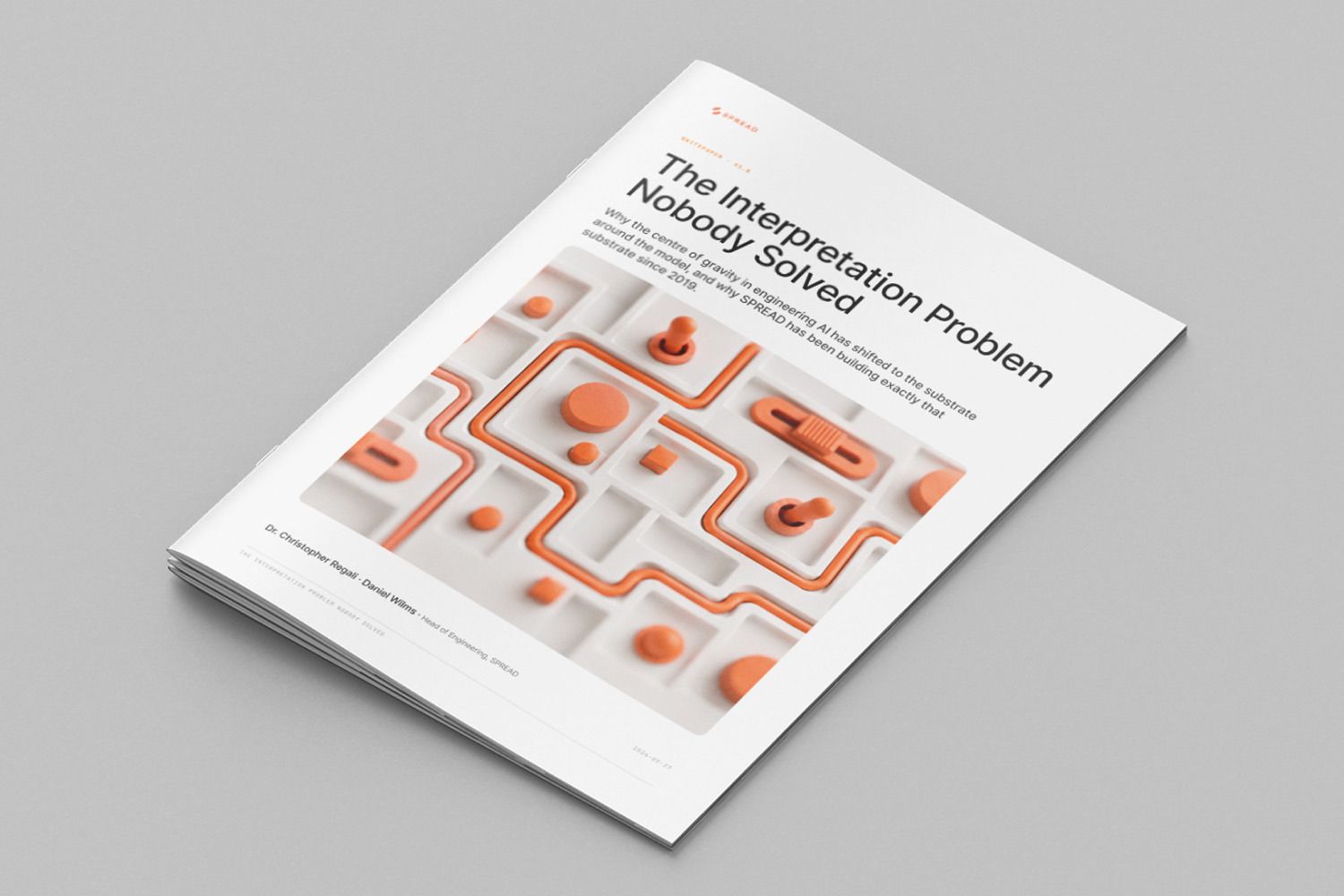
That gap is the starting point of The Interpretation Problem Nobody Solved, a new SPREAD whitepaper by Dr. Christopher Regali and Daniel Wilms. Its argument is uncomfortable and useful: engineering AI has been watching the model when it should have been watching what sits underneath it.
A million tokens, and still not enough context
Independent benchmarks make awkward reading for anyone selling window size as intelligence. NVIDIA's RULER found that only about half of the models advertising 32k tokens or more still held up at 32k on harder tasks. Adobe's NoLiMa showed ten of twelve models falling below half of their short-input score by 32k once simple keyword matching was removed. BABILong reported that most models effectively use only 10 to 20% of their window for multi-hop reasoning.
The distinction matters. Finding one sentence in a long document is retrieval. Engineering is interpretation. A question such as "Which variants are affected if this signal changes?" crosses requirements, functions, ECUs, variant rules and release history. Every fact changes the meaning of the next.
The part no model can memorise
Then comes the deeper problem. Much of engineering meaning has never been written down in a form a model could learn. "There is no public OEM variant model in any pretraining corpus," the paper notes. The rules live in systems, release histories, tool chains and the accumulated judgement of the people who built them.
A larger prompt cannot retrieve a relationship nobody made explicit. It can only conceal the absence for longer.
Software found a thermostat. Engineering did not.
The recent leap in coding agents did not come from bigger windows alone. It came from tools, harnesses and quality gates. Code compiles or it does not. Tests pass or fail. The model can act, observe the error and try again. It no longer has to be brilliant in one pass.
Product engineering has no equivalent safety rail. As Regali and Wilms put it: "Variant logic does not compile. An OEM ontology does not have a test runner. A signal-coverage decision does not produce an exit code."
The paper follows that missing check through thirty years of attempted fixes, then makes the case for a different foundation: a typed engineering knowledge graph with time, provenance and a data model hardened against real customer systems. It explains why GraphRAG alone is not enough, what trustworthy AI agents for engineering need, and why SPREAD built its Product Knowledge Graph before the current agent wave arrived.
Get the whitepaper for the full argument: the benchmark evidence, the missing quality gate, and the four-part foundation engineering AI needs underneath the model.
FAQ
What is a context window in an LLM?
The context window is the maximum amount of text a language model can accept at once. The amount it can use reliably may be much smaller.
What is the difference between nominal and effective context?
Nominal context is the advertised window size. Effective context is how much of that input the model can actually reason over.
What is context rot?
Context rot is Chroma's term for performance degrading as input length grows, even when the model handles the same task well with less context.
Do bigger context windows make AI better at engineering?
Only at the margin. Engineering depends on relationships, history and provenance, not simply on fitting more text into a prompt.