Steer projects with product maturity, error insights, and data governance
Monitor product maturity, manage releases, and align changes across system dependencies. Empower teams with a centralized overview to ensure readiness and improve lifecycle performance from design to production.
What can you achieve with this use case?
Trusted by











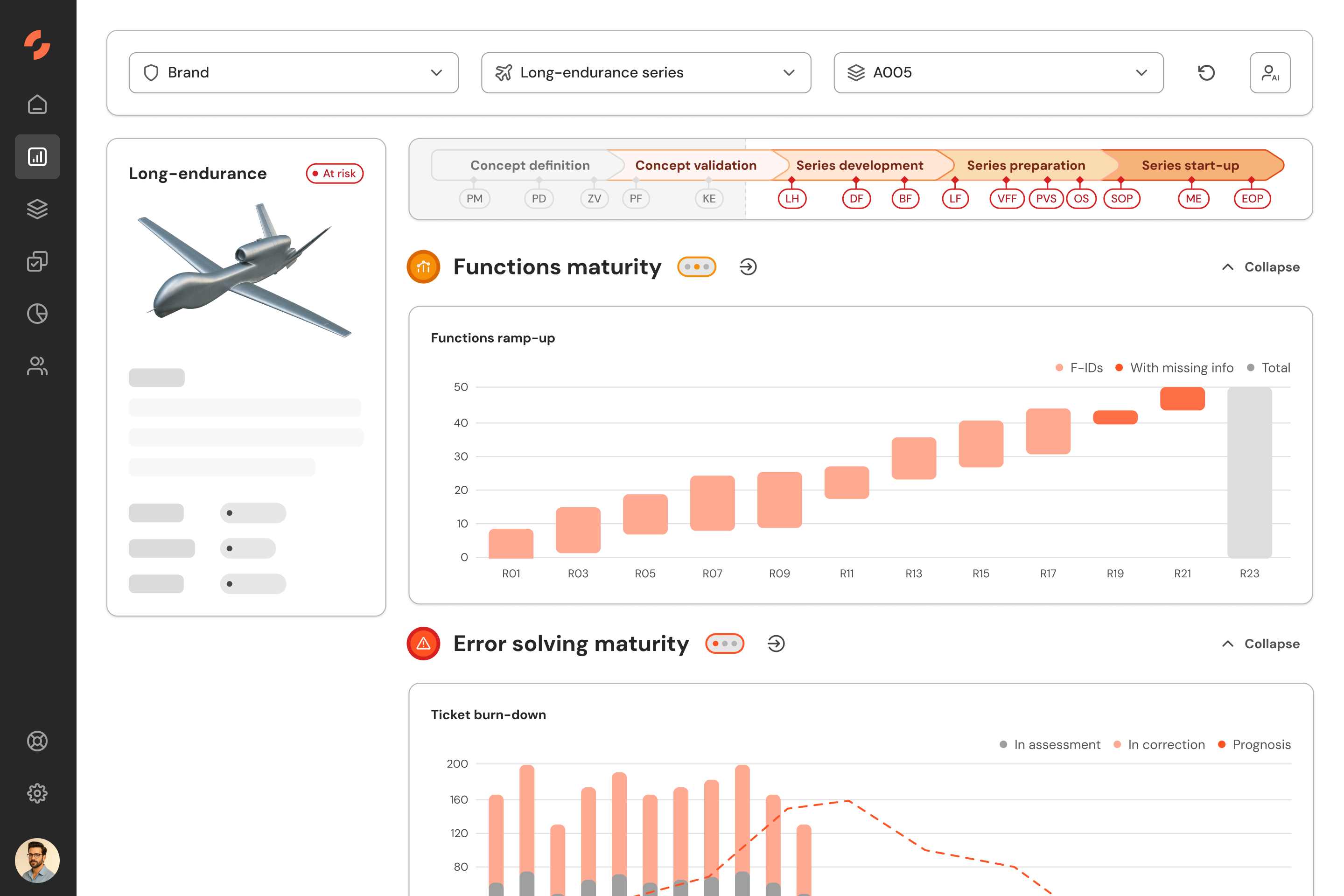
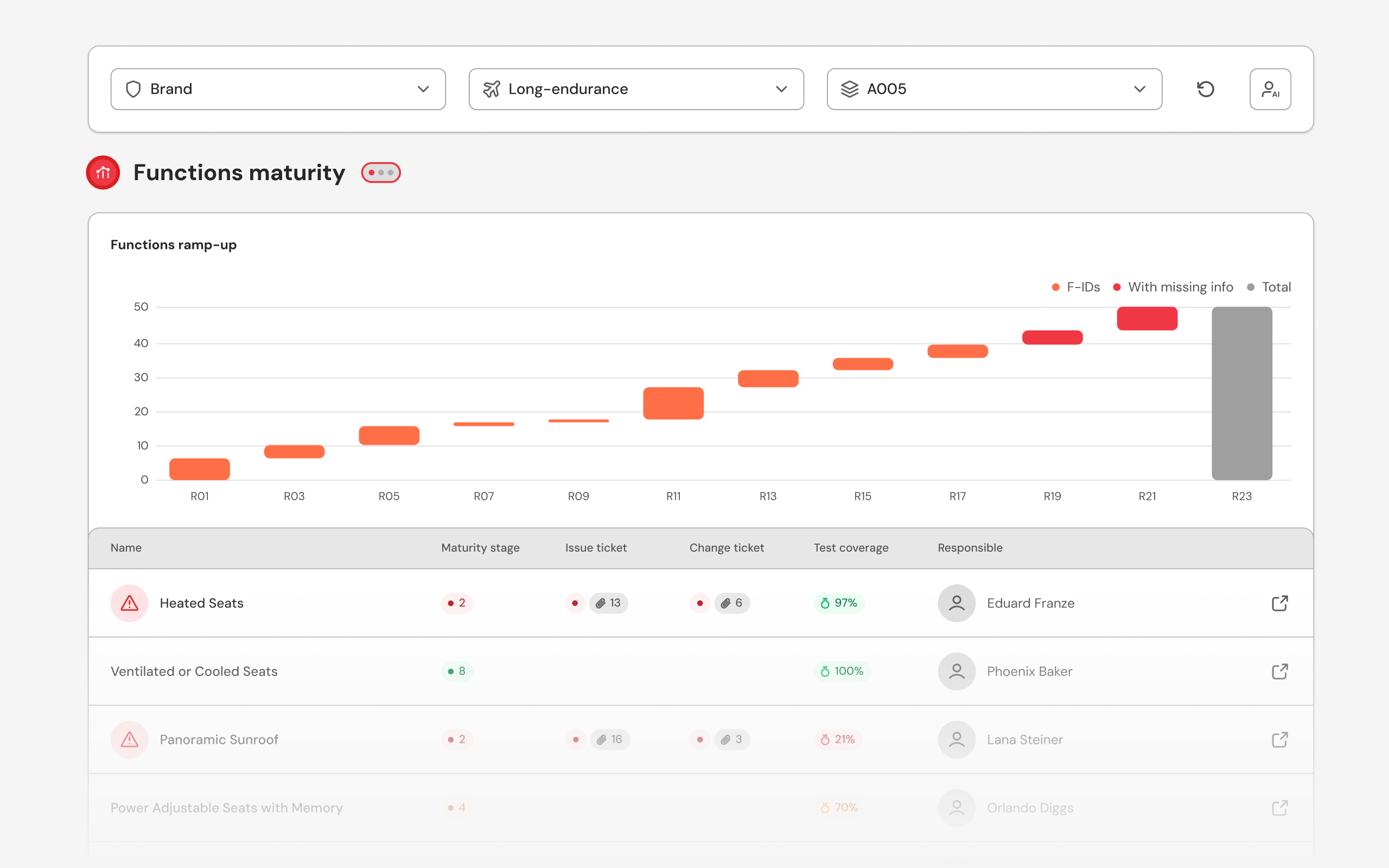
Monitor product maturity in real-time
Monitor status on product maturity, showing current state and planned functional ramp-ups, releases, and SW & HW component readiness. This enables actionable decision-making and prioritization, as well as detailed deep-dives where needed, all supported by connecting system data to ensure nothing is overlooked.
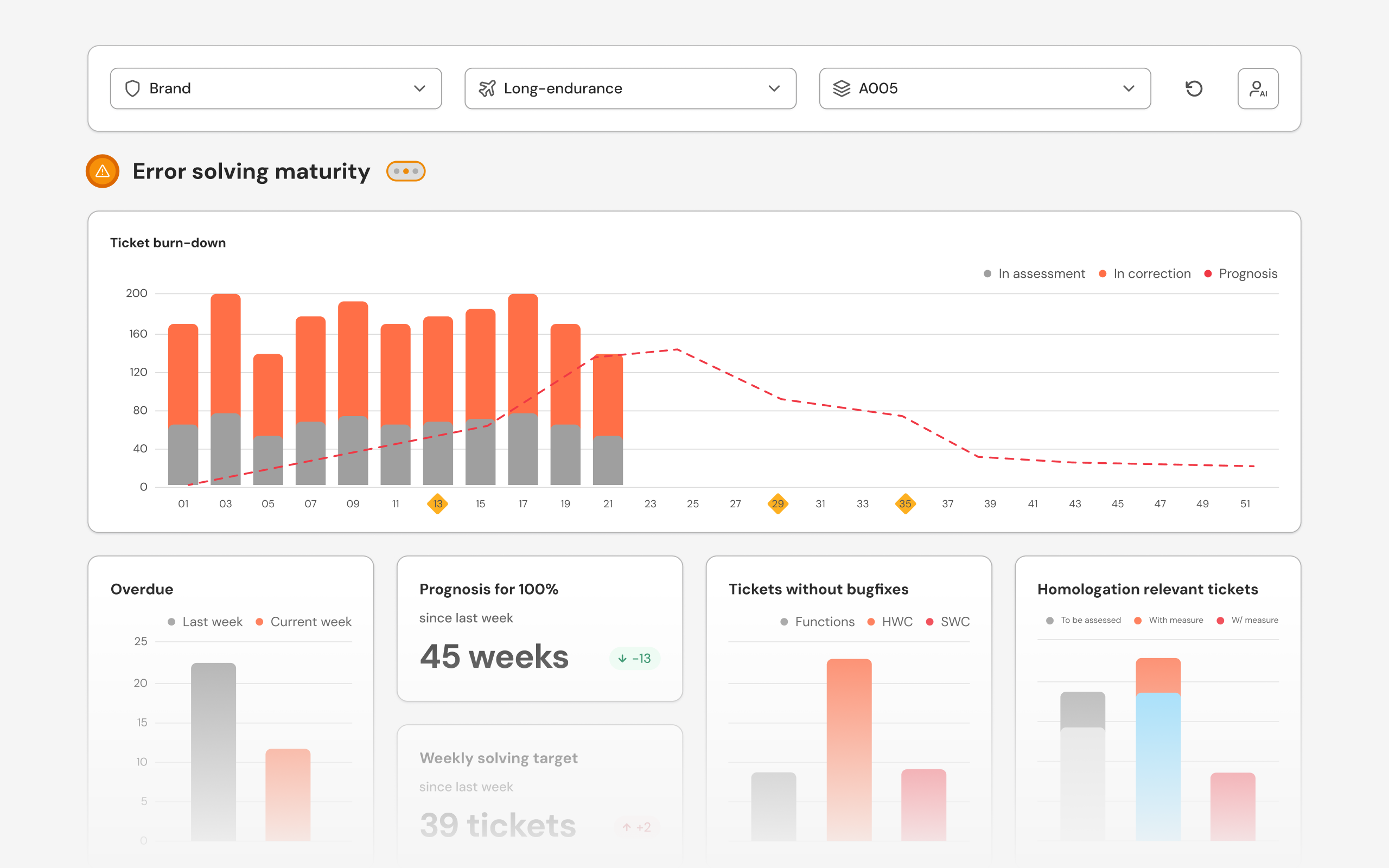
Easily keep track on errors
Automatically generate and unify error and issue status into a comprehensive report. Track historic trends, planned vs. actual issues predictions, and critical KPIs, while highlighting the most severe and long-lasting issues. By linking errors to product maturity, you can assess risks and derive effective mitigations.
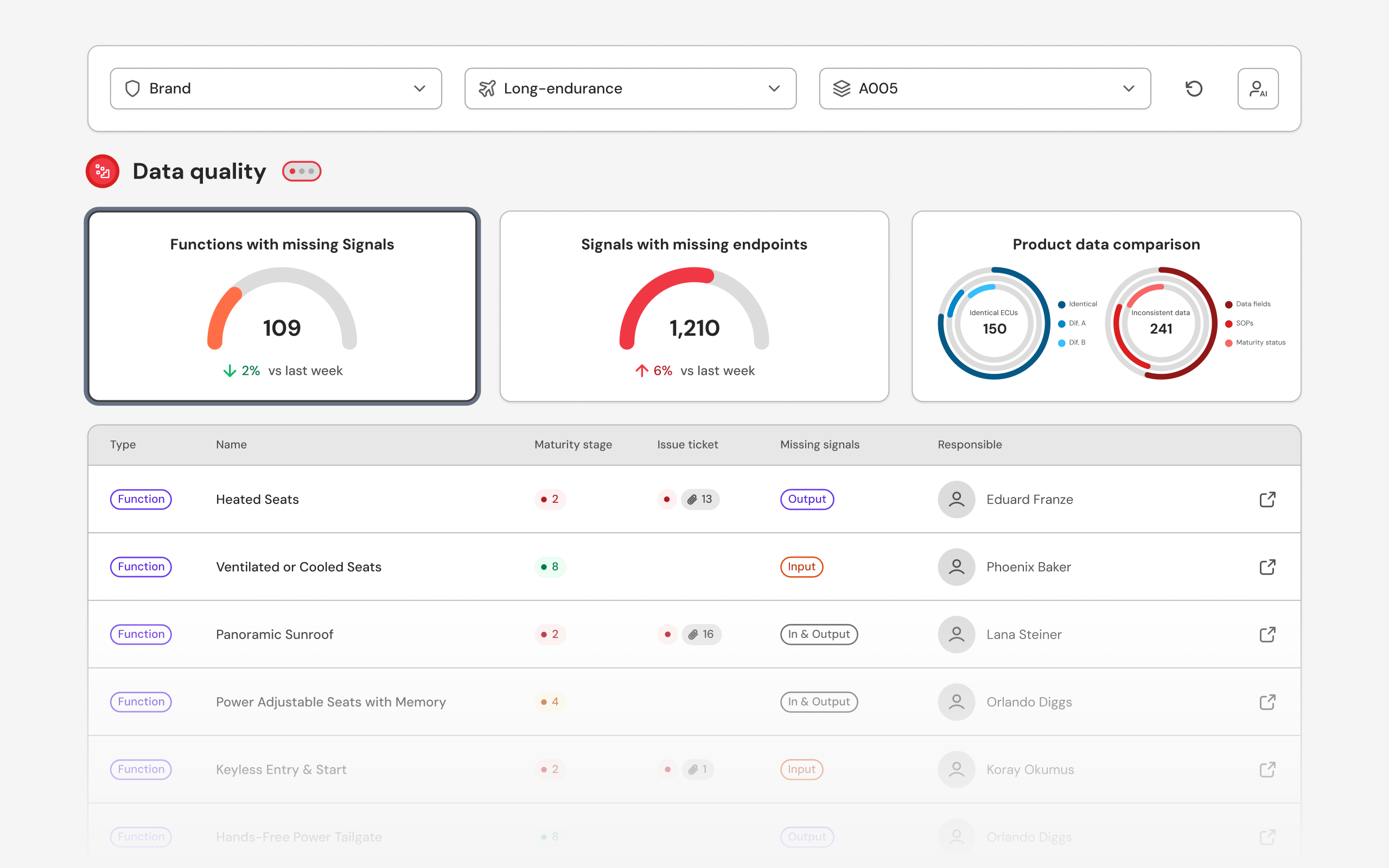
Ensure data quality and governance
Assess the quality of data critical for steering your project from an architecture perspective, focusing on completeness, and consistency. Easily identify gaps that slow down engineering processes. Take action by engaging the responsible teams or departments to ensure strong data governance and project efficiency.
Get an instant tour
See how SPREAD turns complex product data into clear, actionable insights. Take a quick tour and see how this solutions deliver impact.
Get an Instant Tour
By submitting you agree to our privacy policy.
What types of data does SPREAD connect and analyze?
SPREAD integrates critical R&D data from multiple engineering systems and unstructured sources to provide complete traceability from issues to root cause. It connects and contextualizes:
| Data Type | Description | Typical sources | File Formats needed |
|---|---|---|---|
| Function Data | Mappings between logical functions, software modules, and hardware components (including function hierarchy and realizations) | Company specific system |
.json
.xml
|
| Signal Data | Sender-receiver mappings, communication buses, signal properties, variants | Signal databases |
.dbc
.arxml
|
| Vehicle Architecture | Logical and physical structure: components, ECUs, buses, gateways, topologies | Company specific system |
.json
.xml
|
| Variant Configuration | Mapping of feature/function/component presence across vehicle variants | Company specific system |
.json
.xml
|
| Issue Tickets | Description, criticality, affected car, software release, affected function incl. linked parts & software, … | Company specific system |
|
| Data definition | As-is-state of signals, sender-/receiver-ECUs as well as the defined bits | Company specific system |
.arxml
|
Engineering success in action
confidently and unlock innovation with SPREAD.
FAQ
What is Engineering Intelligence ?
SPREAD’s Engineering Intelligence is a specialized network of AI agents designed specifically for engineers. It is built on three core layers: Rapid Date Ingestion: Connectors integrate data from diverse engineering tools, creating a unified environment where AI agents access structured and unstructured data. Product Twin (PT): Powered by a robust Knowledge Graph, the PT is a digital replica of each product that organizes and contextualizes data, offering a single source of truth. It enables AI agents to analyze product relationships, anticipate challenges, and deliver context-aware insights. Action Cloud: This processing hub is where SPREAD’s AI agents operate, automating tasks like compliance checks, requirements optimization, and error management. Together, these layers enable engineers to focus on innovation while Agentic EI manages the data-intensive tasks.
What is an Engineering Intelligence Graph (EI Graph) ?
The Engineering Intelligence Graph (EI Graph) is the core technology behind SPREAD, mapping and linking various data points and relationships within product data to provide a comprehensive and actionable overview. If you like to learn more about it, please watch our video: Introduction to GraphQL.
What types of data does SPREAD connect and analyze?
Action Tower integrates critical R&D data from ticketing systems, PLM tools, and testing platforms, including:
- Issue tickets: Problems, part numbers, linked release references, and unresolved dependencies.
- Maturity inputs: Readiness indicators for functions, components, and systems.
- Dependency data: Hierarchies and relationships between components, functions, and systems.
- Test coverage data: Validation results to identify gaps or incomplete tests.
- Release information: Version control, planned vs. actual release schedules, and configuration details.
How does SPREAD Action Tower integrate with existing systems, including PLMs and PDMs?
Action Tower seamlessly connects with PLM systems (e.g., Siemens Teamcenter, Dassault, etc.), ticketing tools (e.g., Jira, KPM, Azure DevOps), and testing platforms to pull live updates. The solution ensures real-time traceability of bottlenecks, dependencies, and readiness metrics.
What kinds of delays or inefficiencies can Action Tower prevent?
Action Tower prevents delays and inefficiencies by:
- Resolving bottlenecks: Identifying readiness-critical functions or components causing integration delays.
- Improving test coverage: Highlighting incomplete or redundant validation efforts.
- Aligning dependencies: Avoiding late-stage conflicts in software, hardware, or system integration.
What kinds of insights does Action Tower provide?
- Maturity tracking: Real-time visibility into readiness for functions, components, and vehicle variants.
- Bottleneck resolution: Identification of critical issues and resource prioritization.
- Testing progress: Insights into validation gaps and retesting requirements.
- Project alignment: Dependency mapping across components and functions to improve efficiency.
- Data quality and governance: Provides insights into missing signals, incomplete endpoints, and discrepancies between data sources, allowing teams to take corrective actions and maintain data integrity across the project lifecycle.
Can the solution be customized to meet my specific R&D requirements?
Yes, Action Tower allows flexibility in defining workflows, ticket ingestion, and maturity tracking dashboards. The solution can be tailored to align with your R&D toolchain, project goals, and engineering processes, ensuring seamless integration.
How does SPREAD Action Tower assist with recurring ticket analysis?
Action Tower links recurring issues to shared components, functions, and dependencies. This enables teams to detect patterns across tickets, identify systemic bottlenecks, and resolve recurring issues earlier to reduce delays and inefficiencies.
How does SPREAD Action Tower stay updated with product and release changes?
Action Tower dynamically syncs with ticketing systems and PLM tools, ensuring real-time updates for dependencies and readiness metrics. Any changes in tickets, configurations, or releases are reflected instantly, enabling continuous diagnostics and accurate tracking.
Can you show me how SPREAD Action Tower works?
Yes, we'd be happy to schedule a follow-up meeting to demonstrate how Action Tower can integrate with your workflow. Reach out to us through our website or contact our team directly to book your session.
How to
get started
1
Jointly scope
use cases
We bring practical expertise to understand your challenges and scope the right solutions with you.
2
Deploy solutions
rapidly
Within weeks we deploy our platform, integrate the required product data and configure the defined solutions.
3
Rollout across
the company
We train users across teams, scale company-wide, and support you continuously on the way.