










<img height="1" width="1" style="display:none;" alt="" src="https://px.ads.linkedin.com/collect/?pid=5292226&amp;fmt=gif">
Skip to content

Action Tower

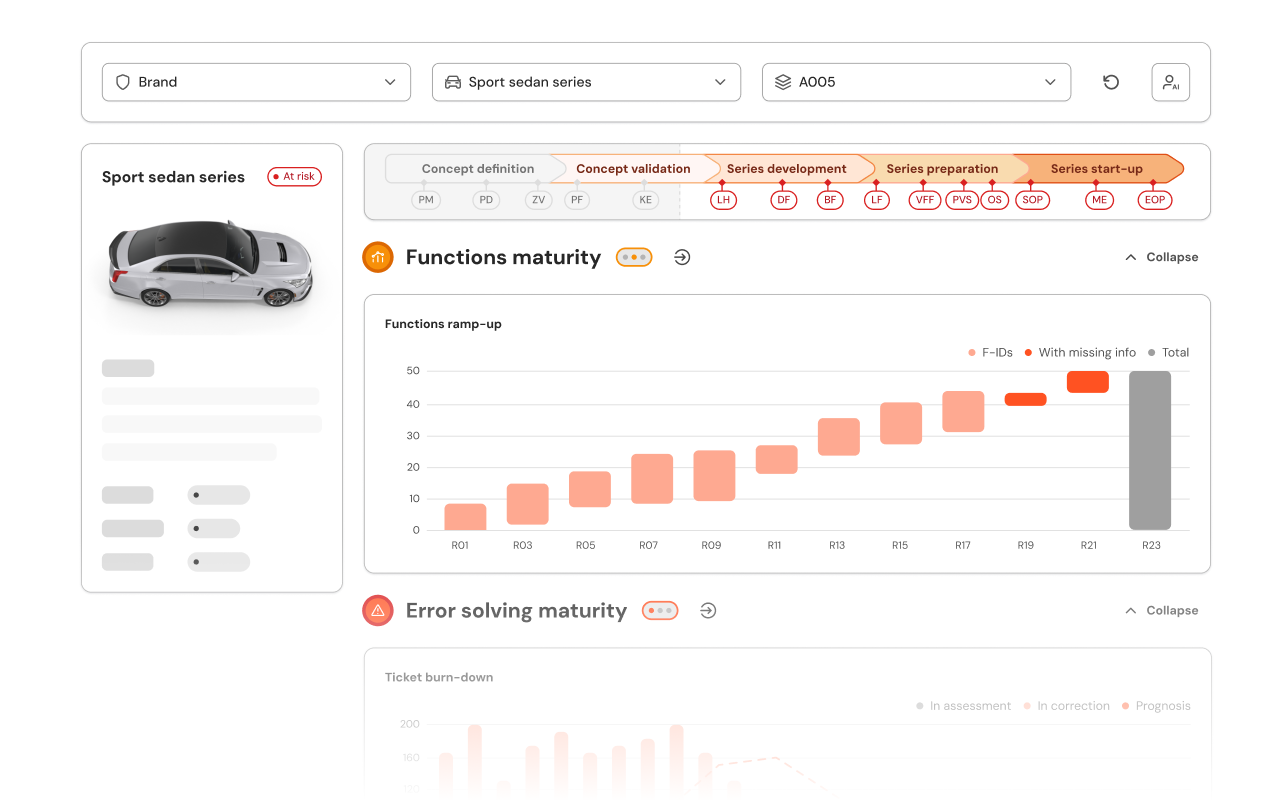
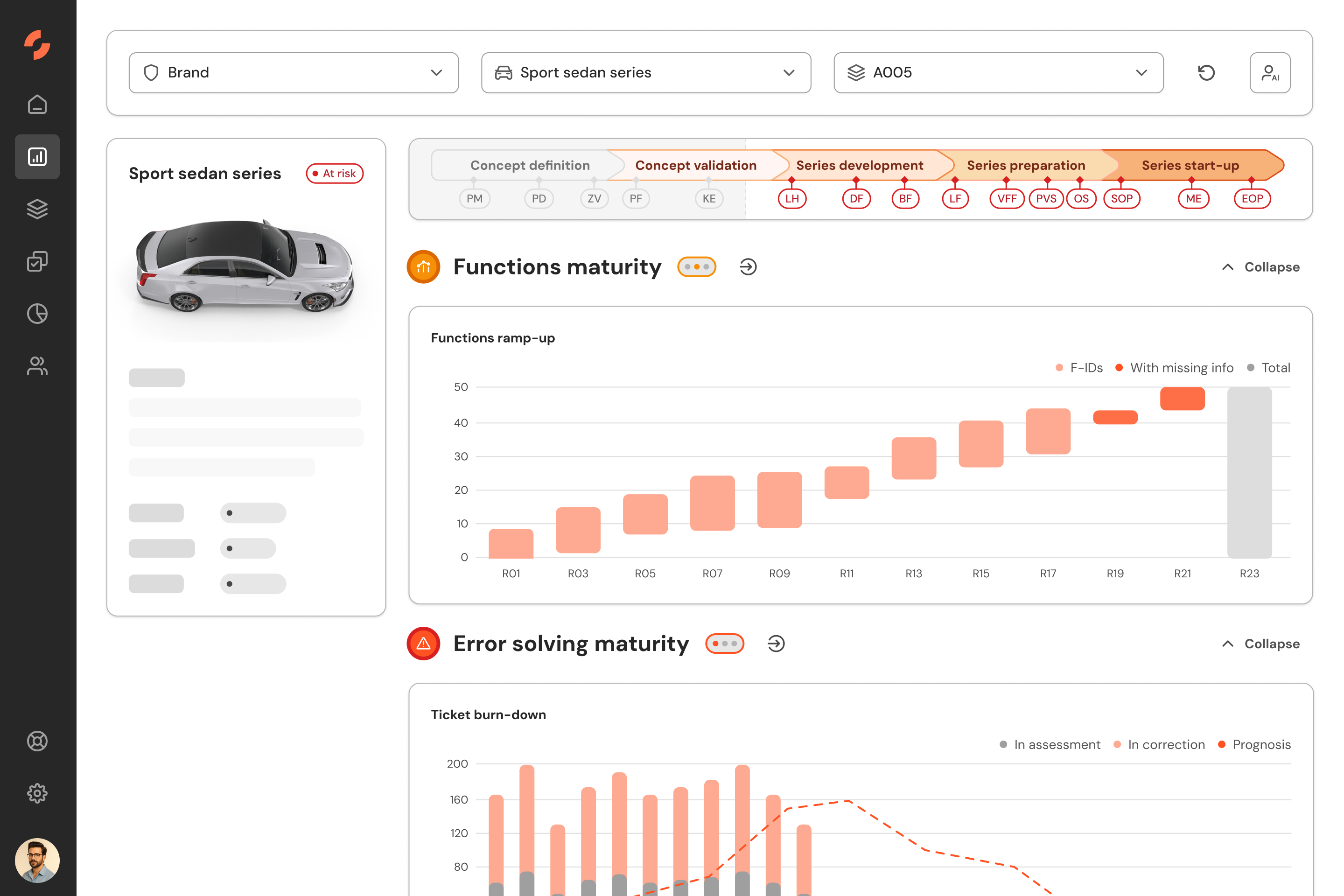
Gain complete visibility and control over product maturity

Action Tower consolidates product data across R&D, Production, and Aftermarket to provide a unified view of product maturity and performance. This visibility helps track changes, optimize quality, and resolve errors faster, ensuring better decision-making and smoother operations throughout the lifecycle, from R&D to aftermarket.

Gain complete visibility and control over product maturity

What can you achieve with SPREAD's solutions?

up to
30%
development costs reduction
up to
40%
SOP delay reduction
up to
10%
lower warranty costs

Trusted by


Use Cases
Action Tower

What types of data does SPREAD connect and analyze?

SPREAD integrates critical data from multiple engineering systems and unstructured sources to provide complete traceability from issues to root cause. It connects and contextualizes:

Data Type Description Typical sources File Formats needed
Function Data Mappings between logical functions, software modules, and hardware components (including function hierarchy and realizations) Company specific system
.json .xml
Signal Data Sender-receiver mappings, communication buses, signal properties, variants Signal databases
.dbc .arxml
Vehicle Architecture Logical and physical structure: components, ECUs, buses, gateways, topologies Company specific system
.json .xml
Variant Configuration Mapping of feature/function/component presence across vehicle variants Company specific system
.json .xml
Issue Tickets Description, criticality, affected car, software release, affected function incl. linked parts & software, … Company specific system
Data definition As-is-state of signals, sender-/receiver-ECUs as well as the defined bits Company specific system
.arxml

FAQ

What is Engineering Intelligence ?

SPREAD’s Engineering Intelligence is a specialized network of AI agents designed specifically for engineers. It is built on three core layers: Rapid Date Ingestion: Connectors integrate data from diverse engineering tools, creating a unified environment where AI agents access structured and unstructured data. Product Twin (PT): Powered by a robust Knowledge Graph, the PT is a digital replica of each product that organizes and contextualizes data, offering a single source of truth. It enables AI agents to analyze product relationships, anticipate challenges, and deliver context-aware insights. Action Cloud: This processing hub is where SPREAD’s AI agents operate, automating tasks like compliance checks, requirements optimization, and error management. Together, these layers enable engineers to focus on innovation while Agentic EI manages the data-intensive tasks.

What is an Engineering Intelligence Graph (EI Graph) ?

The Engineering Intelligence Graph (EI Graph) is the core technology behind SPREAD, mapping and linking various data points and relationships within product data to provide a comprehensive and actionable overview. If you like to learn more about it, please watch our video: Introduction to GraphQL.

What types of data does SPREAD connect and analyze?

The solution pulls from a variety of data sources, including wiring harness data (such as kbl/vec standards), electronic component data, diagnostic protocols, the Bill of Materials (BOM) and more. This information is processed to provide detailed, VIN-specific diagnostics and troubleshooting.

How does SPREAD Action Tower integrate with existing systems, including PLMs and PDMs?

SPREAD Action Tower seamlessly integrates with your existing diagnostic tools, wiring harness data, engineering databases, and Product Lifecycle Management (PLM) or Product Data Management (PDM) systems. By pulling data directly from BOM, ECU communication networks, and diagnostic protocols, the solution bridges the gap between R&D, Production, and Aftermarket phases.

Can SPREAD Action Tower be customized to meet my specific production requirements?

Yes, SPREAD Action Tower can be tailored to fit your specific needs. Whether it’s integrating with your existing toolchain, customizing error detection rules, or adjusting visualization preferences, the solution is highly flexible. You can also use our platform to build your own cloud-based solutions for specific use cases.

How does SPREAD Action Tower improve troubleshooting for connectors?

SPREAD Action Tower provides real-time tracking of signal paths between connectors and components. Technicians can view detailed wiring and signal diagrams, including pin-level data and connector housing specifications, allowing for quick identification and replacement of faulty connectors.

How does Action Tower use the data it processes to improve production?

Action Tower analyzes the processed data to identify performance patterns, track errors, and diagnose issues at the sensor, station, and component levels. By linking real-time data with historical insights, it helps production teams prioritize critical issues, reduce rework, and optimize overall production efficiency.

What kinds of errors can SPREAD Action Tower

SPREAD Action Tower can detect a wide range of errors, including:

  • Communication errors between control units (ECUs)
  • Ground and supply errors
  • Hardware/software mismatches in installed components
  • Component failures detected during diagnostic tests
  • Test errors, such as interrupted or abandoned diagnostic procedures

How does SPREAD Action Tower update with changes in vehicle design or manufacturing?

SPREAD Action Tower continuously updates based on the latest engineering and manufacturing data. For example, whenever there’s a change in the BOM or wiring configuration, the solution automatically reflects these updates in the VIN-specific diagrams and troubleshooting protocols.

What types of data does SPREAD connect and analyze?

Action Tower integrates critical R&D data from ticketing systems, PLM tools, and testing platforms, including:

  • Issue tickets: Problems, part numbers, linked release references, and unresolved dependencies.
  • Maturity inputs: Readiness indicators for functions, components, and systems.
  • Dependency data: Hierarchies and relationships between components, functions, and systems.
  • Test coverage data: Validation results to identify gaps or incomplete tests.
  • Release information: Version control, planned vs. actual release schedules, and configuration details.

How does SPREAD Action Tower integrate with existing systems, including PLMs and PDMs?

Action Tower seamlessly connects with PLM systems (e.g., Siemens Teamcenter, Dassault, etc.), ticketing tools (e.g., Jira, KPM, Azure DevOps), and testing platforms to pull live updates. The solution ensures real-time traceability of bottlenecks, dependencies, and readiness metrics.

What kinds of delays or inefficiencies can Action Tower prevent?

Action Tower prevents delays and inefficiencies by:

  • Resolving bottlenecks: Identifying readiness-critical functions or components causing integration delays.
  • Improving test coverage: Highlighting incomplete or redundant validation efforts.
  • Aligning dependencies: Avoiding late-stage conflicts in software, hardware, or system integration.

What kinds of insights does Action Tower provide?

  • Maturity tracking: Real-time visibility into readiness for functions, components, and vehicle variants.
  • Bottleneck resolution: Identification of critical issues and resource prioritization.
  • Testing progress: Insights into validation gaps and retesting requirements.
  • Project alignment: Dependency mapping across components and functions to improve efficiency.
  • Data quality and governance: Provides insights into missing signals, incomplete endpoints, and discrepancies between data sources, allowing teams to take corrective actions and maintain data integrity across the project lifecycle.

Can the solution be customized to meet my specific R&D requirements?

Yes, Action Tower allows flexibility in defining workflows, ticket ingestion, and maturity tracking dashboards. The solution can be tailored to align with your R&D toolchain, project goals, and engineering processes, ensuring seamless integration.

How does SPREAD Action Tower assist with recurring ticket analysis?

Action Tower links recurring issues to shared components, functions, and dependencies. This enables teams to detect patterns across tickets, identify systemic bottlenecks, and resolve recurring issues earlier to reduce delays and inefficiencies.

How does SPREAD Action Tower stay updated with product and release changes?

Action Tower dynamically syncs with ticketing systems and PLM tools, ensuring real-time updates for dependencies and readiness metrics. Any changes in tickets, configurations, or releases are reflected instantly, enabling continuous diagnostics and accurate tracking.

Can you show me how SPREAD Action Tower works?

Yes, we'd be happy to schedule a follow-up meeting to demonstrate how Action Tower can integrate with your workflow. Reach out to us through our website or contact our team directly to book your session.

What types of data does SPREAD Action Tower connect and analyze?

Action Tower aggregates real-time field data, including fleet performance, failure trends, service events, and warranty claims. It also integrates repair records, recall data, and cost analytics, providing aftermarket teams with a structured overview for proactive issue resolution.

How does the solution integrate with existing systems, including PLMs and PDMs?

The solution can connect various data sources, including CAD models, Bills of Materials (BoM), wiring harness data (KBL/VEC standards), spare parts catalogs, service records, failure reports, and warranty claims. This structured view supports lifecycle updates and enables proactive issue resolution for aftermarket operations.

Can Action Tower be customized to meet my specific Aftermarket requirements?

Yes, Action Tower is designed to adapt to Aftermarket needs. It provides visibility into repair workflows, installed components, and lifecycle data. It is expected to integrate with PLM, PDM, and ERP systems for seamless aftermarket operations.

How does Action Tower enhance visibility into vehicle and component data?

Action Tower provides real-time visibility into fleet performance, failure trends, and warranty claims across markets. By analyzing repair patterns and predictive maintenance insights, aftermarket teams can improve service efficiency, reduce costs, and optimize field operations.

How does Action Tower update with changes in vehicle design or service procedures?

Action Tower seamlessly integrates with ERP, warranty management, and service platforms to consolidate failure data, track cost trends, and optimize service workflows. This ensures end-to-end visibility from failure detection to resolution, reducing downtime and improving aftermarket profitability.

Can you show me how Action Tower works?

Yes, we'd be happy to schedule a follow-up meeting to demonstrate how Action Tower can integrate with your workflow. Reach out to us through our website or contact our team directly to book your session.

How to

get started

1

Jointly scope
use cases

We bring practical expertise to understand your challenges and scope the right solutions  with you.

2

Deploy solutions
rapidly

Within weeks we deploy our platform, integrate the required product data and configure the defined solutions.

3

Rollout across
the company

We train users across teams, scale company-wide, and support you continuously on the way.