
In November, political leaders, industrial executives, and technology builders gathered in Berlin for the Summit on European Digital Sovereignty. German Chancellor Friedrich Merz and French President Emmanuel Macron addressed the meeting alongside ministers, regulators, and representatives from industry and academia to examine how Europe should secure its digital future.
A sovereignty agenda meets an execution challenge
Defense occupied a central place in these discussions. EU-27 defense spending reached €343 billion in 2024, with a record share directed toward equipment procurement. Political alignment and financial commitment are now established at a scale not seen in decades.
The unresolved question is whether this investment can be converted into operational capability within the timeframes that contemporary security conditions demand.
Europe’s window of opportunity is narrow but clear. Investment levels, political alignment, and industrial capacity have converged in a way that may not recur soon. Whether this moment translates into sustained advantage will depend less on formal commitments than on execution over the next development cycles.

Philipp Noll, co-founder and managing director at SPREAD, in conversation with German Chancellor Friedrich Merz and French President Emmanuel Macron during the Franco-German Summit on European Digital Sovereignty in Berlin.
During the summit, exchanges between policymakers and industry leaders increasingly turned from institutional frameworks to execution constraints. In one working session, SPREAD’s co-founder and managing director Philipp Noll discussed with Chancellor Merz and President Macron how engineering infrastructure shapes Europe’s capacity to design, integrate, certify, and upgrade complex systems under compressed timelines. Across the summit, digital sovereignty was treated less as a regulatory objective and more as a question of operational capability.
The new constraint in modern defense programs
Contemporary defense systems no longer follow long, sequential hardware development cycles. They are software-defined, continuously updated, and tightly coupled across vehicles, sensors, command systems, and multinational supply chains. Their engineering requires the coordination of thousands of dependencies across mechanical, electrical, and software domains while certification regimes and interoperability standards continue to evolve.
Under these conditions, the principal constraint is rarely funding or technical competence. It lies in the movement of engineering knowledge across complex organizations. In most defense programs, essential product information remains distributed across disconnected tools and teams. Requirements, architectures, validation results, and production standards are reconciled manually. Design changes propagate through layers of coordination, retesting, and renewed certification. Program delays arise less from technical infeasibility than from the difficulty of governing complexity at scale.
The pace at which this complexity can be managed increasingly determines program outcomes.
The implications extend beyond defense programs themselves. The capacity to execute complex engineering cycles at speed increasingly shapes industrial competitiveness, supply chain resilience, and Europe’s ability to sustain a technologically sovereign industrial base.
Engineering speed without losing control
Acceleration alone does not confer advantage in defense programs. Iteration must remain compatible with traceability, certification, and system integrity. That balance depends on digital foundations capable of representing engineering logic as a continuous system rather than as a sequence of handoffs between tools and organizations.
At SPREAD, this requirement informed the development of the Engineering Intelligence Platform. By unifying requirements, system architectures, components, software, validation data, production information, and in-service feedback into functional Product Twins, engineering knowledge becomes explicit and continuously traceable. Design changes propagate across domains with full visibility into system impact. Variant complexity remains governed as architectures evolve.
This architecture alters the economics of execution. Validation cycles shorten. Engineering teams devote less time to reconciliation and more to integration. Certification proceeds with greater predictability as iteration accelerates.
Execution speed in practice
Several European defense programs now operate on this foundation.

Dr. Marc Honikel, VP Engineering at Rheinmetall Air Defense, on using Product Twins to accelerate certified delivery across platforms, variants, and national requirements.
At Rheinmetall Air Defense, growth in demand placed sustained pressure on engineering throughput. The Defense Product Twin developed for the Skyranger system links system requirements, component structures, and software dependencies across disciplines. The resulting transparency reduced redundant testing, improved system comprehension, and enabled continuous validation across the lifecycle, supporting faster deployment and higher operational readiness.

Dr. Ulrich Nuding, Engineering Director Germany at MBDA, on building trusted engineering data foundations to accelerate complex defense development.
At MBDA Germany, direct integration between engineering models and manufacturing validation removed one of the slowest transitions in complex programs. Design changes now propagate automatically into production standards. Certification timelines shortened, traceability strengthened, and iteration became compatible with regulatory requirements.
Taken together, these programs illustrate a structural change in defense execution. Engineering speed is no longer a by-product of organizational efficiency. It has become an independent capability.
From digital sovereignty to execution sovereignty
Debates on digital sovereignty have largely concentrated on cloud jurisdiction, infrastructure ownership, and data residency. These questions remain central to governance. Operational sovereignty, however, rests on a broader foundation: the ability to preserve national, industrial, and technical optionality by retaining control over how complex systems are designed, integrated, certified, and evolved over time.
Defense readiness increasingly rests on the capacity to adapt architectures rapidly, integrate multinational systems reliably, and upgrade deployed platforms continuously. Programs that progress fastest are not those that relax controls, but those whose engineering foundations allow iteration without loss of traceability.
Sovereignty, in this sense, is exercised through execution.
Building Europe’s execution layer
The Berlin summit confirmed broad agreement on the strategic relevance of artificial intelligence, digital sovereignty, and industrial capability. Translating this consensus into operational outcomes now requires coordination across programs, suppliers, and national boundaries.
Execution will depend on digital infrastructures designed for software-defined defense, procurement regimes compatible with iteration, and shared standards that permit engineering intelligence to circulate securely across the European defense ecosystem.
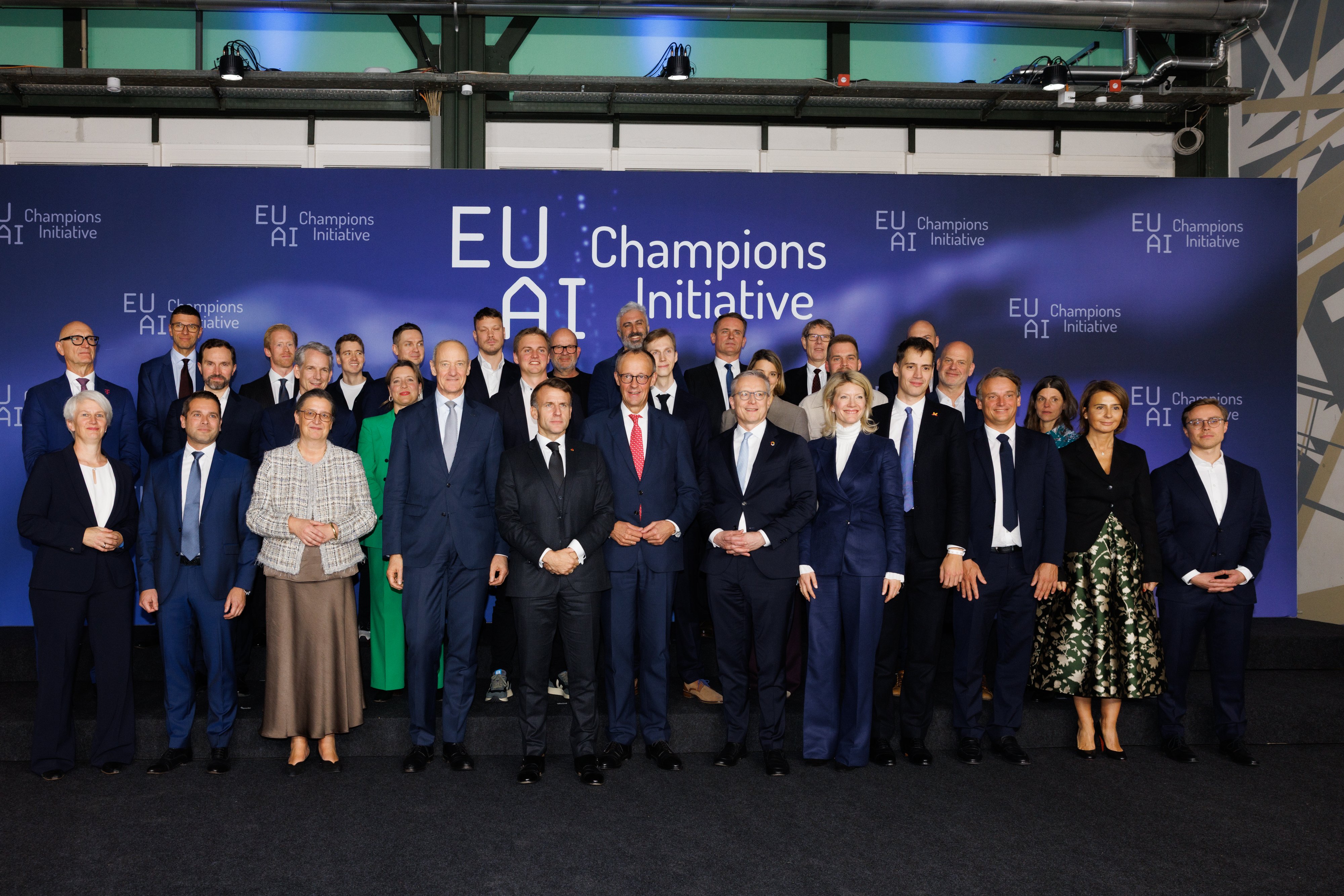
Leaders from government, industry, and technology at the European Digital Sovereignty Summit in Berlin, convened under the EU AI Champions Initiative to advance Europe’s strategy for sovereign and competitive artificial intelligence.
Within this framework, the EU AI Champions Initiative reflects a broader effort to anchor AI-driven value creation in Europe’s industrial core. Since its launch earlier this year, the initiative has mobilized more than €20 billion in AI-related investments and established partnerships between leading industrial groups and European AI companies, with a clear objective: ensure that productivity gains, system control, and strategic know-how remain anchored on the continent.
Among the collaborations announced in Berlin, the joint program between MBDA, Rheinmetall, and SPREAD demonstrates how engineering intelligence, digital sovereignty, and execution speed can be aligned within a single development cycle.
A European advantage worth sustaining
Europe enters this period with a distinctive industrial tradition.
Its competitiveness has long rested on precision, certification, and system integrity, on the ability to design and operate complex technologies reliably over long lifecycles. This tradition underpins Europe’s leadership in aerospace, automotive, energy, and defense, and continues to shape how safety, interoperability, and public trust are governed.
The strategic challenge is not to replace that tradition with speed. It is to make it compatible with speed.
As defense systems become software-defined and continuously evolving, execution time increasingly determines operational relevance. Programs that cannot integrate, certify, and upgrade systems within compressed cycles lose effectiveness regardless of their technical quality. At the same time, programs that accelerate without preserving traceability and control incur unacceptable risk.
Under these conditions, speed becomes a structural capability. Not speed as haste, but speed as disciplined execution: the capacity to iterate rapidly while preserving system understanding, certification integrity, and operational safety.
Digital sovereignty follows the same logic. Autonomy depends not only on ownership of infrastructure or jurisdiction over data, but on sustained control over how complex systems are designed, integrated, and evolved over time.
Engineering intelligence is central to that control.
Over time, this capacity will shape not only defense readiness, but Europe’s ability to sustain long-term productivity, industrial leadership, and technological independence.
By making product logic explicit, traceable, and shared across disciplines, Europe can combine what has always distinguished its industrial base with what the next generation of defense systems requires. Execution cycles shorten without weakening rigor. Adaptation accelerates without eroding trust.
In this environment, speed does not replace quality It becomes the means by which quality, reliability, and strategic autonomy are preserved.