This article was written by Ricardo Trindade, Design Lead at SPREAD AI. Ricardo leads the Design team, driving collaboration and excellence across SPREAD’s platform ecosystem. With a background spanning graphic, industrial, and digital product design, he ensures a consistent, user-centric experience that makes complex engineering solutions intuitive, coherent, and pleasant to use.
Engineers spend their days navigating complexity. Their tools should not add to it. At SPREAD, we obsess over the details that reduce cognitive load and increase clarity. Even capitalization is a UX decision. We standardize on sentence case across our products because it helps people read faster, decide faster, and trust the interface more.
Below is what that choice means for our users and why it aligns with modern product design.
Natural to read, lower cognitive load
People read interfaces, they do not study them. Sentence case mirrors everyday writing, which makes it easier to scan and comprehend.
Micro-examples
Buttons
- Sentence case: Save changes
- Title case: Save Change
Alerts
- Sentence case: We could not sync your data. Try again in a few minutes.
- Title case: We Could Not Sync Your Data. Try Again In A Few Minutes.
Why it matters: sentence rhythm improves readability at a glance.
Form labels
- Sentence case: Vehicle platform
- Title case: Vehicle Platform
Why it matters: consistent, quiet labels do not compete with the values that matter.
Result: less visual noise, natural reading.
Clear across languages and contexts
Our users are global. In German, for example, all nouns are capitalized. Title case can create false signals about meaning, and mixed-language screens become harder to parse. Sentence case is a neutral ground that travels well.
Example
English string inside a German workflow
- Sentence case: Add component
- Title case: Add Component
For a German reader, the second looks like two nouns. The first reads like an action.
Result: less ambiguity for multilingual teams, smoother collaboration across sites and suppliers.
Frictionless for design and development
Title case invites debate about what counts as a “title.” Tabs, checkboxes, modal headers, inline confirmations: are they titles or controls? Sentence case removes that decision tree.
What this unlocks
- Faster design reviews, since capitalization is deterministic
- Fewer QA defects for “inconsistent capitalization”
- Easier localization handoff, since translators get a single rule
- Clearer content rules in the system library
Result: teams ship consistent interfaces with less back-and-forth.
Alignment with modern product design
Different design systems make different choices about capitalization. For example, Apple uses title case in its interfaces, while Google, Microsoft and Atlassian use sentence case. What matters is that each company applies its rule consistently.
At SPREAD, we’ve chosen sentence case because it aligns with our goal of reducing cognitive load in dense, technical interfaces. It’s easier to scan at small sizes and high information density, which is where our users spend much of their time.
Where we apply it
- Buttons, menus, tabs, table headers
- Form labels, helper text, tooltips, empty states
- Notifications, toast messages, inline errors
- Page titles and modal titles, unless a proper noun is present
Result: an interface that feels consistent, disciplined, and purposefully calm.
Details that build trust
Trust is cumulative. Predictable capitalization makes the interface feel considered and reliable. It also supports the tone we want in engineering software: professional, direct, human.
Tone guidance
- Use sentence case for UI copy to keep it approachable and precise
- Reserve uppercase only for non-UI codes and true abbreviations, for example VIN, ECU, ISO 26262
- Avoid “Title Case for Importance.” Importance is conveyed by layout, hierarchy, and contrast, not by capital letters
Result: a product voice that feels confident, deliberate, and quietly professional.
Exceptions that keep language exact
Sentence case is the default. Certain cases remain capitalized for accuracy.
Keep these capitalized
- Proper nouns and product names: Data Mapper, Requirements Manager, Ticket Analyzer
- Standards and abbreviations: ISO 26262, DOORS, CAN
- Legal names and trademarks: as registered, e.g. SPREAD
- Code snippets and schema keys: as written in the system
Result: clarity without losing precision.
What you will notice in SPREAD
Our commitment to sentence case shows up in small, repeatable moments that remove friction for engineers working across tools.
- Faster wayfinding in dense tables and explorers, since labels are visually lighter and actions stand out
- Cleaner forms with consistent labels, hints, and validation messages that read like plain language
- More focus on the object of work, not on formatting quirks that change from screen to screen
- Smoother onboarding for teams coming from heavy PLM or PDM interfaces, since the language feels familiar and predictable
Sentence case is not a style preference. It is a usability choice that removes friction, improves global comprehension, and supports a modern, trustworthy product voice. When the interface gets out of the way, engineers can focus on engineering.
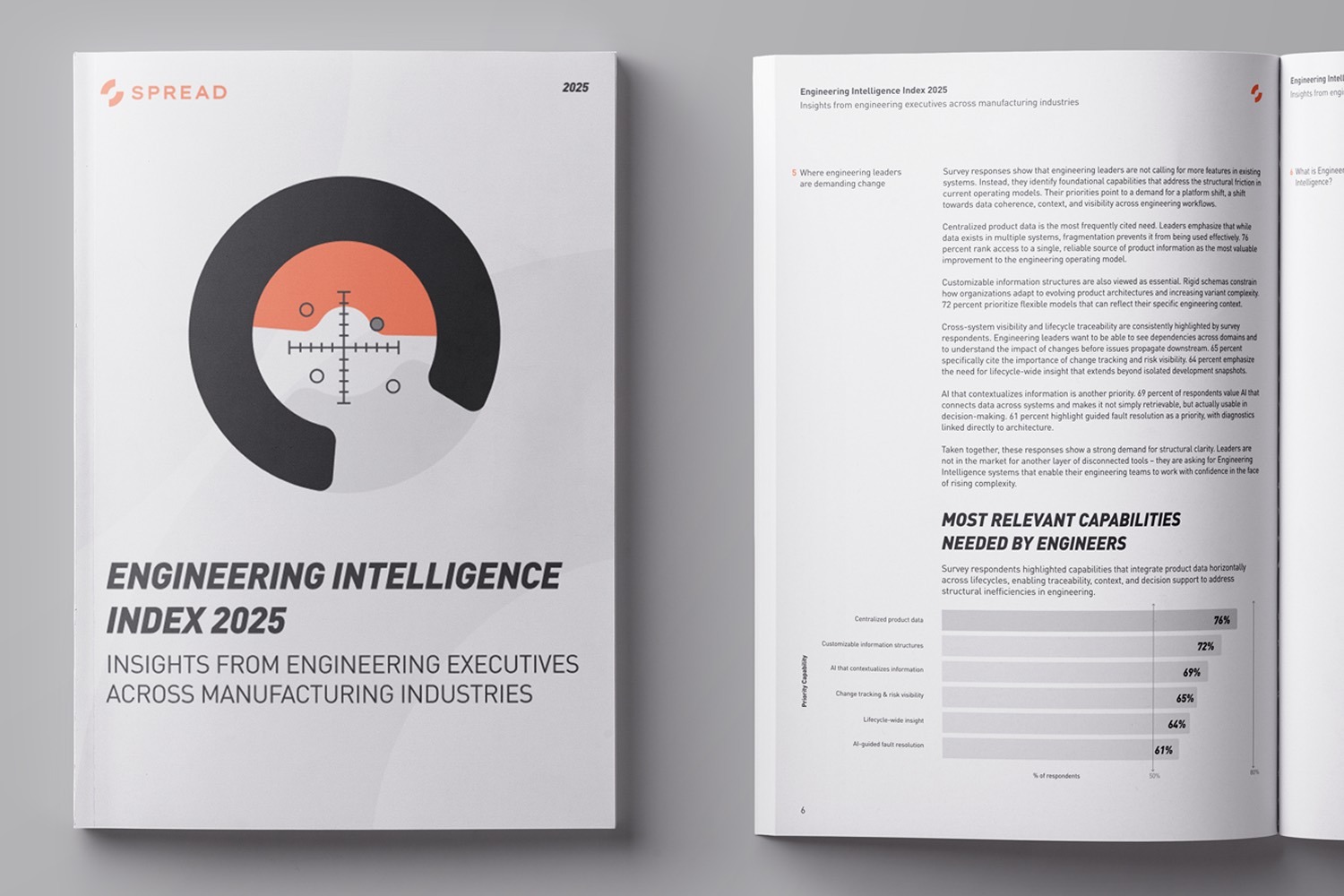
FREE REPORTThe Engineering Intelligence Index 2025How engineering teams are coping with software-defined complexity, and where the leaders pull ahead. Survey data and benchmarks.Get the report